
The frame is the skeleton of your sofa. Everything else — the cushions, the fabric, the springs — sits on top of it. But most people never think about how that skeleton is held together until it starts creaking, wobbling, or falling apart. That’s where joinery comes in.
Joinery refers to how the individual pieces of the sofa frame are connected at their joints. A corner joint held together with wood glue and a single screw will fail in a few years. A mortise and tenon joint cut from kiln-dried hardwood can last decades. The difference in price between those two sofas might be $300. The difference in lifespan could be 20 years.
This guide explains every major sofa frame joinery type, what makes each one strong or weak, how to spot them in the store, and exactly which price tiers use which methods.
Key Takeaways
- Mortise and tenon is the strongest joinery type used in sofa frames. It creates a mechanical lock between frame pieces and is found in high-end sofas priced above $2,000.
- Double dowel joinery is a reliable mid-range method that uses two wooden pegs per joint for alignment and shear resistance. Found in $800–$2,000 sofas.
- Corner blocks are triangular wood reinforcements glued and screwed into frame corners. They are a sign of quality when added alongside primary joinery methods.
- Staple-only construction is the weakest method. It relies entirely on metal staples with no mechanical interlock. Common in sofas under $500.
- Glue alone fails under racking stress — the side-to-side force that builds up every time you sit down or shift your weight. The best frames combine glue, mechanical fasteners, and reinforcing blocks.
- You can test joinery quality in a store by lifting one front leg two inches off the floor. If the frame twists or creaks, the joinery is weak.
What Is Sofa Frame Joinery and Why Does It Matter?
Quick Answer: Sofa frame joinery is the method used to connect individual wood pieces at their meeting points. It determines how well the frame resists stress over time. Weak joinery causes wobbling, creaking, and structural failure. Strong joinery keeps a sofa solid for 15 to 30 years.
Every sofa frame is made of individual pieces of wood — rails, legs, posts, and cross members. Those pieces have to connect somewhere. The joint is that connection point, and how it’s made determines whether the whole structure holds up or breaks down.
The main stress a sofa joint faces is called racking stress. This is the sideways, twisting force created every time someone sits down, stands up, or shifts position. Over thousands of cycles, racking stress is what separates a well-built joint from a poorly built one.
Secondary stresses include compression (weight pressing straight down) and tension (pulling forces when someone leans back). A good joint handles all three. A staple-only joint struggles with all three.
What Are the Different Types of Stress a Sofa Frame Faces?
Understanding the forces on a sofa helps you understand why some joints fail and others don’t. Here’s a breakdown of the three main stress types and which joinery methods resist them best.
| Stress Type | Description | Best Resisted By | Worst Case |
|---|---|---|---|
| Racking Stress | Sideways/twisting force from sitting and shifting | Mortise and tenon, double dowel + corner blocks | Staple-only |
| Compression | Downward force from body weight | All joinery types with solid hardwood | Particleboard with staples |
| Tension | Pulling force from leaning back | Mortise and tenon, glued dowels | Single screw connections |
What Is Mortise and Tenon Joinery in a Sofa Frame?

Quick Answer: Mortise and tenon is a joinery method where one piece of wood has a protruding peg (tenon) cut to fit into a matching hole (mortise) in the adjoining piece. It creates a mechanical lock that resists racking stress without relying solely on glue or fasteners.
This is the oldest and strongest wood joinery method used in furniture. The tenon — a rectangular peg shaped from the end of one board — slots into the mortise — a precisely cut rectangular hole in the other board. When glued, the mechanical interlock and the glue surface area combine to create a joint that is often stronger than the wood itself.
In sofa construction, mortise and tenon joints are most commonly used where the arms meet the back posts and where the seat rails connect to the legs. These are the highest-stress points in the frame.
How Strong Is Mortise and Tenon Compared to Other Methods?
A properly cut mortise and tenon joint in kiln-dried hardwood can resist shear forces exceeding 1,500 lbs per joint in lab testing. For comparison, a single-dowel joint in similar wood resists roughly 600–800 lbs of shear force. A staple-based butt joint typically fails below 200 lbs of lateral force.
The key word is “properly cut.” A loose-fitting tenon with gaps — common when manufacturers cut costs on machining — reduces that strength significantly. Fit should be snug enough that the joint holds before glue is applied.
| Joinery Type | Shear Resistance | Typical Price Tier | Lifespan (Regular Use) | Repairability |
|---|---|---|---|---|
| Mortise and Tenon | 1,200–1,800+ lbs per joint | $2,000–$8,000+ | 20–30+ years | Moderate (requires disassembly) |
| Double Dowel | 800–1,200 lbs per joint | $800–$2,500 | 12–20 years | Moderate |
| Corner Block + Glue | 600–900 lbs (system) | $600–$1,500 | 10–18 years | Fairly Easy |
| Single Dowel + Glue | 400–700 lbs per joint | $400–$1,000 | 6–12 years | Moderate |
| Staple-Only | Under 200 lbs per joint | Under $600 | 2–5 years | Difficult/Not Worth Repairing |
Which Wood Species Work Best with Mortise and Tenon?
The joint is only as strong as the wood around it. Hardwoods like kiln-dried oak, maple, and beech have the grain density to hold a tight mortise without splitting. Softwoods like pine can work but are more prone to compression at the tenon shoulders over time.
Engineered wood products — particleboard and MDF — should never be used for mortise and tenon joints. The material crushes and crumbles at the joint under racking stress, regardless of how well the joint is cut.
What Is Double Dowel Joinery in Sofa Frames?
Quick Answer: Double dowel joinery uses two round wooden pegs, typically 3/8 to 1/2 inch in diameter, inserted into matching holes drilled in both frame pieces. The two-dowel system prevents rotation at the joint and provides solid resistance to shear and racking forces.
A single dowel lets the joint rotate around the peg like a pin. Adding a second dowel a few inches away stops that rotation completely. That’s the core advantage of the double dowel system. It’s a significant mechanical upgrade over single-dowel construction at a relatively small cost increase.
Double dowel joinery is glued at assembly. The dowels are pre-coated with wood glue, inserted into pre-drilled holes, and the joint is clamped until the glue cures. The result is a joint that relies on both the mechanical fit of the dowels and the glue surface area between the two boards.
Where Are Double Dowels Typically Used in a Sofa Frame?
In mid-range sofas, you’ll find double dowels at most major frame joints: where legs meet rails, where seat rails connect to corner posts, and sometimes where arm rails meet the back frame. High-end manufacturers combine double dowels with corner blocks and wood glue at every joint for a belt-and-suspenders approach.
Budget-tier sofas sometimes use a single dowel — or no dowel at all — and rely on staples or screws to hold the joint. You can often feel this difference when you press sideways on the arm of a sofa. A well-doweled joint feels rigid. A staple joint has slight give.
What Are Corner Blocks and How Do They Strengthen a Sofa?
Quick Answer: Corner blocks are triangular or square pieces of hardwood glued and screwed into the interior corners of a sofa frame. They distribute racking stress across a wider surface area, preventing the corner joint from opening under load. They are a standard quality indicator in mid-range and high-end sofas.
Think of a corner block as a gusset. In engineering, a gusset is a reinforcing plate added to a joint to make it more rigid. Corner blocks do the same job in wood. By bridging the two frame members meeting at a corner, a block adds triangular rigidity — the strongest geometric form for resisting deformation.
Corner blocks are almost always used as a supplement to another joinery method, not as a standalone system. A mortise and tenon frame with corner blocks is exceptionally strong. Corner blocks alone, without a quality primary joint, add less value than manufacturers sometimes imply.
What Are the Different Types of Corner Blocks Used in Sofas?
| Corner Block Type | Material | Attachment Method | Quality Signal | Typical Price Tier |
|---|---|---|---|---|
| Solid Hardwood Block | Oak, maple, or beech | Glued + screwed (2 screws min) | Strong | $1,200–$5,000+ |
| Solid Softwood Block | Pine or fir | Glued + screwed (2 screws) | Moderate | $600–$1,500 |
| Plywood Block | Layered plywood | Glued + stapled or screwed | Moderate (better than MDF) | $500–$1,200 |
| MDF/Particleboard Block | Engineered wood | Glued + stapled | Weak (crumbles under stress) | Under $700 |
| Metal Bracket | Steel L-bracket | Screwed | Moderate (no give, can loosen) | $400–$900 |
How Can You Tell If a Sofa Has Corner Blocks Without Taking It Apart?
Turn the sofa upside down or look underneath through the base dust cover. Most quality sofas have a dust cover — a thin fabric layer stapled to the bottom. If the manufacturer allows you to check, you can peel back a corner of that fabric and look for the triangular wood blocks at each interior corner.
If the sofa has a removable seat cushion, sometimes you can also feel the block through the seat platform fabric at the corner points. A firm, unyielding resistance at the corners — compared to flexibility in the center — is a good sign.
What Is Staple-Only Sofa Frame Construction?
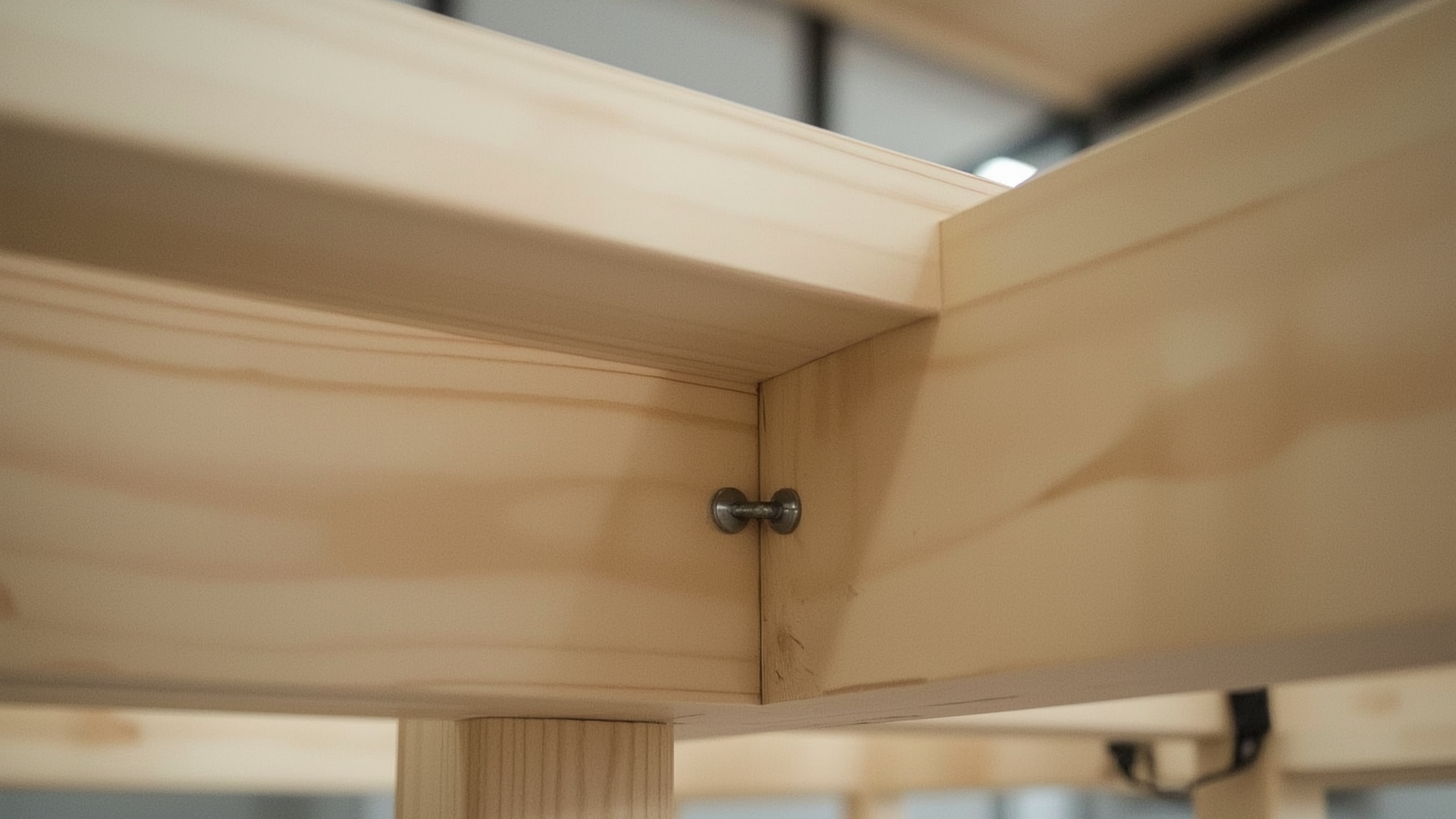
Quick Answer: Staple-only construction uses metal staples as the primary fastener to join sofa frame pieces together. There is no mechanical interlock between the wood pieces. Under repeated racking stress, staples loosen, wood fibers compress around the staple shank, and the joint fails — often within 2 to 5 years of regular use.
Industrial staples can hold surprising amounts of force in a single direction. The problem is that sofa joints face force in multiple directions simultaneously. When a staple is loaded sideways — which happens every time you sit or shift — the staple pries upward against the wood grain. Over thousands of cycles, the wood fibers around the staple shank compress and the staple begins to pull out.
There’s no repair for a staple-only frame that has started to fail. You can add corner blocks or external brackets, but the original joint surface has already been damaged. The sofa becomes a short-term piece.
How Do You Spot Staple-Only Construction Before You Buy?
The price is often the first signal. Sofas under $400 to $600 rarely use anything better than staple-based construction. But price isn’t always reliable — some mid-range brands charge $800 to $1,000 for staple-built frames.
The in-store test is more reliable. Sit on the sofa and shift your weight side to side. Then lift one front corner about two inches off the floor and watch whether the opposite back corner rises with it. If it does, the frame is rigid. If the frame twists — meaning the two diagonally opposite corners don’t move together — the joinery is weak, regardless of what the tag says.
You can also try pushing sideways on the arm. Any lateral wobble in the arm where it meets the seat frame indicates inadequate joinery at that joint.
How Does Glue Factor Into Sofa Frame Joinery?
Quick Answer: Wood glue is used alongside mechanical joinery methods to increase surface-area bonding between frame pieces. Yellow PVA wood glue, when properly clamped and cured, forms a bond stronger than the surrounding wood fibers. Glue alone — without mechanical fasteners — fails under racking stress because it has no shear resistance.
Wood glue works through surface bonding. When two pieces of flat-grained hardwood are glued together with proper clamping pressure, the dried glue layer becomes essentially part of the wood. That glued joint can be incredibly strong in direct compression or tension along the grain.
The weakness of glue-only joints is peel force and racking. Think of it like tape — tape holds flat surfaces together firmly, but if you peel it at an angle, it releases. Sofa joints under racking stress are constantly experiencing that peel-angle force. That’s why the best frames always combine wood glue with at least one mechanical element: a dowel, a tenon, or a corner block.
What Types of Wood Glue Are Used in Sofa Frames?
| Glue Type | Bond Strength | Water Resistance | Typical Use | Quality Signal |
|---|---|---|---|---|
| PVA (Yellow Glue) | High (3,600–4,000 psi tensile) | Low | Interior frames, corner blocks | Standard for quality builds |
| Polyurethane Glue | Very High (3,500–4,500 psi tensile) | High | High-end frame joints | Premium signal |
| Hide Glue | High (allows joint reversal) | Very Low | Traditional and artisan furniture | High-end, craftsman signal |
| Hot Melt (Glue Gun) | Low | Moderate | Budget assembly, non-structural trim | Warning sign at structural joints |
What Role Does Wood Species Play in Frame Joinery Strength?
Quick Answer: Wood species determines how well a frame holds mechanical fasteners, resists splitting at joint cuts, and holds glue bonds over time. Kiln-dried hardwoods like oak, maple, and beech are the strongest choices. Softwoods and engineered boards significantly reduce the effectiveness of every joinery method.
A mortise and tenon joint cut into kiln-dried oak performs very differently from the same joint cut into construction-grade pine. The oak resists compression at the tenon shoulders. It holds glue across a dense grain structure. The pine compresses at stress points and can split along the grain after years of seasonal movement.
Kiln drying matters because it removes moisture from the wood before it becomes part of a frame. Green or partially dried wood continues to shrink and move after assembly. That movement puts stress on every joint in the frame, even well-built ones. Kiln-dried hardwood that has been dried to 6 to 8 percent moisture content is stable enough to maintain tight joint tolerances for decades.
Which Wood Species Are Most Commonly Used in Sofa Frames?
| Wood Species | Janka Hardness | Moisture Stability | Typical Frame Use | Price Tier |
|---|---|---|---|---|
| Kiln-Dried Oak | 1,290 lbf | Excellent | High-end primary frame | $2,000–$8,000+ |
| Kiln-Dried Maple | 1,450 lbf | Excellent | High-end primary frame | $2,000–$6,000+ |
| Kiln-Dried Beech | 1,300 lbf | Very Good | Mid-to-high-end primary frame | $1,000–$4,000 |
| Poplar | 540 lbf | Good | Mid-range secondary members | $600–$1,800 |
| Pine (Kiln-Dried) | 380–870 lbf | Moderate | Mid-range and budget frames | $400–$1,200 |
| Particleboard/MDF | N/A (engineered) | Poor | Budget frames only | Under $600 |
How Do You Test Sofa Joinery Quality in the Store?

Quick Answer: Lift one front leg two inches off the floor while pressing down on the opposite rear corner. A rigid frame stays flat — all four points move together. A weak frame twists. Also push sideways on the arm, listen for creaks while sitting, and ask to see the underside of the frame if the store allows.
Most stores will let you perform these tests without issue. You’re not damaging anything — you’re applying the same forces the sofa will experience every day in your home.
The lift test (also called the twist test) is the most diagnostic. When you lift one corner, the frame acts like a rectangle under diagonal force. A rigid frame — one where all the joints are working — resists the twist and lifts as a unit. A weak frame twists because the joints aren’t transmitting force efficiently across the diagonal.
What Should You Ask the Sales Team About Frame Construction?
Ask these specific questions and pay attention to whether the sales team can answer without hesitation:
- What wood species is used in the primary frame members?
- Is the wood kiln-dried?
- What joinery method is used at the arm-to-seat connection?
- Are corner blocks present, and are they hardwood?
- Is wood glue used at all joints, or just at certain points?
Vague answers like “it’s solid wood” or “high-quality construction” without specifics are a warning sign. A manufacturer proud of their joinery will have that information available.
How Does Joinery Quality Match to Sofa Price Tiers?
Quick Answer: Entry-level sofas under $600 almost always use staple-based construction on particleboard or pine frames. Mid-range sofas ($800–$2,000) use double dowel joinery with corner blocks on kiln-dried hardwood. Sofas above $2,000 typically feature mortise and tenon joinery with full glue and block reinforcement.
Price is not a perfect predictor — some brands charge mid-range prices for budget construction. But the price-to-joinery relationship is consistent enough to serve as a starting filter.
The critical cutoff is around $800 to $1,000. Below that threshold, it becomes very difficult to source kiln-dried hardwood, employ skilled frame assembly, and maintain meaningful quality control. Above $1,500, competition among manufacturers pushes them toward better joinery to justify the price.
What Joinery Should You Expect at Each Price Point?
| Price Range | Typical Frame Material | Primary Joinery | Corner Blocks | Expected Lifespan |
|---|---|---|---|---|
| Under $500 | Particleboard or pine | Staple-only or single screw | Rarely / MDF if present | 2–4 years |
| $500–$800 | Pine or poplar mix | Staple + glue or single dowel | Sometimes (softwood) | 4–8 years |
| $800–$1,500 | Kiln-dried hardwood (beech, poplar) | Double dowel + glue | Usually (hardwood or plywood) | 10–15 years |
| $1,500–$2,500 | Kiln-dried hardwood (oak, beech) | Double dowel + corner blocks + glue | Yes (hardwood) | 15–20 years |
| $2,500+ | Kiln-dried hardwood (oak, maple) | Mortise and tenon + corner blocks + glue | Yes (hardwood, at every corner) | 20–30+ years |
Can a Weak Sofa Frame Joint Be Repaired?
Quick Answer: Some sofa frame joints can be repaired by injecting wood glue, adding corner blocks, or reinforcing with metal brackets. However, repairs are most effective on frames that failed due to glue failure rather than mechanical damage. Staple-pulled joints and split wood are much harder to restore to original strength.
Glue failure is actually the most common and most repairable type of joint failure. The joint was well-made but the glue dried out or was never applied properly at the factory. If the wood itself is undamaged, you can inject fresh PVA glue, clamp the joint, and restore most of its original strength.
Split wood around a staple joint is harder to fix. Once wood fibers tear — which happens when a staple is pulled out under force — the mechanical integrity of that joint area is compromised. Adding a corner block or L-bracket can stabilize the frame, but the original joint surface won’t return to its factory state.
When Is It Worth Repairing vs. Replacing a Sofa Frame?
The repair decision usually comes down to the original construction quality. If the frame is kiln-dried hardwood with double dowel or mortise and tenon joinery, a single failed joint is worth repairing. The rest of the frame has value.
If the frame is particleboard or softwood with staple-only construction, repairing one joint often reveals other failing joints nearby. The failure pattern is systemic, not isolated. Replacement is usually the more economical choice in that case.
Frequently Asked Questions
What does “eight-way hand-tied” have to do with sofa frame joinery?
Eight-way hand-tied refers to the spring system inside the sofa seat, not the frame joinery. Springs are tied in eight directions to distribute weight evenly. A sofa can have excellent eight-way hand-tied springs on a weak staple-only frame — they are independent construction elements. Both matter, but they address different parts of the sofa.
Is a sofa frame made of plywood better than solid wood?
It depends on where plywood is used. Plywood has excellent cross-grain strength and resists splitting when screws or dowels are driven through it. High-quality sofa frames often use plywood for flat platform sections like the seat deck, while using solid hardwood for the rails, legs, and joints. Pure solid hardwood in the structural members is still preferable for primary joinery points.
Do all expensive sofas use mortise and tenon joinery?
Not all high-end sofas use mortise and tenon. Some premium manufacturers use double dowel joinery with hardwood corner blocks at every joint and achieve very similar durability at a slightly lower construction cost. The joinery method matters less than the overall system — wood species, moisture content, glue quality, and block reinforcement all contribute equally to frame longevity.
Can I see sofa frame joinery at the store, or is it always hidden?
In most retail settings, the frame is hidden under upholstery. However, some stores have frame cross-section displays showing cut-away views of their construction. You can also ask to look at the underside of the sofa — many stores allow this. The dust cover fabric on the bottom can sometimes be peeled back at a corner to reveal the internal corner blocks and joint construction.
How does sofa frame joinery affect the warranty?
Frame joinery quality directly correlates with warranty length. Budget sofas with staple-only frames typically carry 1-year frame warranties. Mid-range sofas with double dowel construction usually offer 3 to 5-year frame warranties. High-end manufacturers confident in their mortise and tenon construction often offer lifetime frame warranties. The warranty length is itself a useful quality signal.
Does the type of joinery affect how a sofa sounds over time?
Yes. Creaking is one of the earliest signs of joinery failure. It occurs when two frame pieces that should be held rigidly together begin to move slightly against each other. Mortise and tenon and double dowel frames with proper glue application rarely creak. Staple-only frames often begin creaking within 1 to 3 years as staples loosen and wood fibers compress around the shank.
