
A budget sofa doesn’t have to fall apart in two years. The difference between a cheap sofa that lasts and one that doesn’t comes down to knowing what’s inside it. Frame construction, cushion fill, and fabric grade matter far more than the brand name on the tag.
Most shoppers focus on style and price. Retailers know this, which is why budget sofas often look great in the showroom but sag and pill within months. This guide helps you skip that mistake by showing you exactly what to look for before you buy.
Key Takeaways
- Frame material is the most important factor in a budget sofa’s lifespan. Kiln-dried hardwood beats pine or MDF at every price point.
- Cushion density determines long-term comfort. Look for seat foam rated at 1.8 lb/ft³ or higher, even in budget options.
- Fabric durability is measured in rub counts. Aim for at least 15,000 double rubs for everyday use.
- Secondhand and floor model sofas can deliver significant quality at reduced prices if you know what to inspect.
- Assembly quality and leg attachment are often where budget sofas cut corners. Always check these before purchase.
- Budget doesn’t mean $200. A realistic budget sofa for lasting quality sits between $400 and $900 for most households.
What Does “Budget Sofa” Actually Mean in Terms of Price?
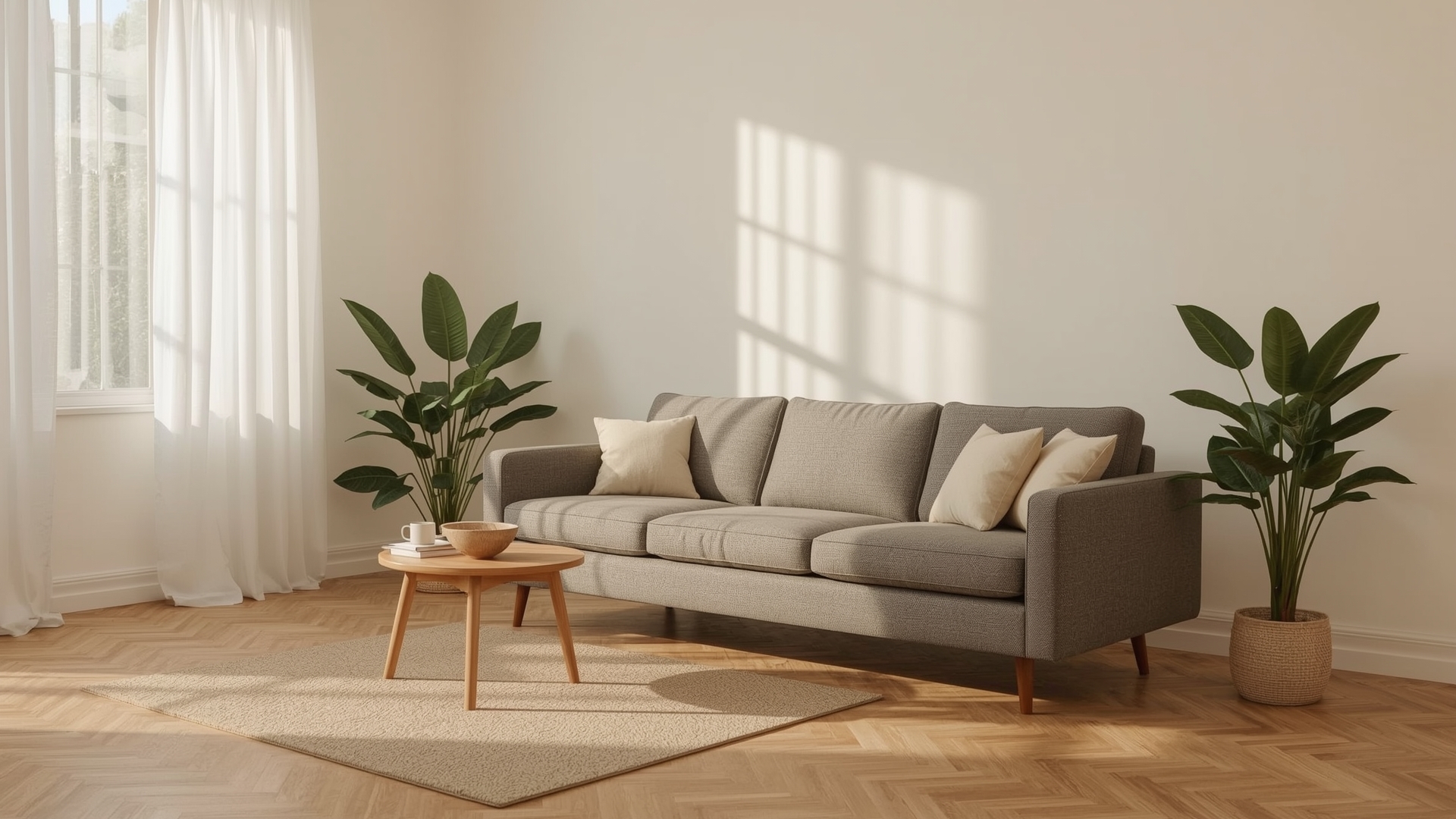
Quick Answer: A budget sofa typically falls between $300 and $900. Under $300, structural quality drops sharply. Between $400 and $900, you can find frames, cushions, and fabrics that hold up with proper care for 5 to 10 years.
Budget means different things depending on who you ask. For a studio apartment with light use, $350 might be plenty. For a family with kids and pets, you’ll want to stretch toward $700 to $900 to get materials that actually hold up.
Sofas under $300 almost always use low-density foam, particle board or MDF frames, and synthetic fabrics with rub counts below 10,000. These sofas look fine in photos but wear out fast under regular use.
Think of the $400 to $900 range as the sweet spot. You’ll start seeing solid wood components, higher-density seat cushions, and fabrics rated for everyday household use. That’s where smart budget shopping begins.
Budget Sofa Price Tiers Compared
| Price Range | Typical Frame | Seat Foam Density | Fabric Rub Count | Expected Lifespan |
|---|---|---|---|---|
| Under $300 | MDF / particle board | Under 1.5 lb/ft³ | Under 10,000 | 1 to 3 years |
| $300 to $500 | Mixed wood / pine | 1.5 to 1.8 lb/ft³ | 10,000 to 15,000 | 3 to 5 years |
| $500 to $900 | Solid hardwood / kiln-dried | 1.8 to 2.0 lb/ft³ | 15,000 to 25,000 | 5 to 10 years |
| $900 to $1,500 | Kiln-dried hardwood | 2.0 to 2.5 lb/ft³ | 25,000 to 50,000+ | 10 to 15 years |
What Frame Materials Should You Look for in a Budget Sofa?

Quick Answer: Look for kiln-dried hardwood like birch, beech, or oak. These resist warping and hold screws tightly over time. Avoid MDF, particleboard, or untreated softwoods like pine, which split and loosen under daily stress.
The frame is the skeleton of your sofa. Everything else sits on top of it. A weak frame leads to wobbling, creaking, and structural collapse, no matter how nice the cushions are.
Kiln-dried hardwood is the standard to aim for. Kiln-drying removes moisture from the wood, which prevents warping, shrinking, and joint failure over time. At budget price points, you’ll sometimes see it used in the main frame even if other components are less premium.
Pine is softer and cheaper. It’s not automatically bad, but untreated pine is prone to cracking under sustained weight. If a retailer lists “solid wood” without specifying the species, ask directly. “Solid wood” legally includes pine and other softwoods.
What Frame Components Signal Quality?
The joints matter as much as the wood species. Dowel and corner block joints hold far longer than stapled or nailed connections. Run your hand under the frame near the corners. If you feel glued wooden corner blocks, that’s a positive sign.
Leg attachment is one of the most common failure points on budget sofas. Look for legs that bolt through the frame rather than screw in from the outside. Screw-in legs loosen with time. Bolted legs stay put.
A simple test: lift one front corner of the sofa a few inches off the ground. If the opposite back leg also lifts, the frame has good torsional rigidity. If the frame flexes and the other leg stays flat, the joinery is weak.
Frame Material Attributes by Type
| Material | Density | Screw Holding | Warp Resistance | Budget Availability | Relative Cost |
|---|---|---|---|---|---|
| Kiln-dried beech | High | Excellent | Excellent | $500+ sofas | Higher |
| Kiln-dried birch | High | Excellent | Very good | $450+ sofas | Moderate |
| Solid pine | Medium | Fair | Fair | $200+ sofas | Low |
| MDF | Medium-low | Poor | Poor | Under $300 sofas | Lowest |
| Particleboard | Low | Very poor | Poor | Under $200 sofas | Lowest |
How Do You Evaluate Cushion Quality Without Opening the Sofa?
Quick Answer: Sit on the sofa and time how long it takes to feel the frame beneath you. Quality seat foam rated at 1.8 lb/ft³ or higher should support your weight evenly for at least 30 minutes. Cushions that compress within 10 minutes have low-density foam.
Cushion density is measured in pounds per cubic foot (lb/ft³). This tells you how much foam is packed into each cubic foot of material. Higher density means more foam, which equals better support and slower breakdown.
For everyday seating, look for seat cushion foam rated at 1.8 lb/ft³ or higher. Budget sofas often use 1.5 lb/ft³ or lower, which feels fine when new but compresses and sags within a year of regular use.
Firmness is a separate measurement called ILD (Indentation Load Deflection). ILD tells you how firm or soft the foam feels. A standard household sofa sits between 30 and 45 ILD. Low ILD with low density is the worst combination for durability.
What Cushion Fills Are Used in Budget Sofas?
Budget sofas use three main fill types: foam only, foam wrapped in polyester fiber, and foam wrapped in a polyester fiber jacket. Pure foam cushions hold their shape the longest at lower price points. Polyester fiber wrapping adds a softer feel but compresses faster.
Down-wrapped cushions are rare at budget prices. When you do see them listed, check whether the listing says “down blend” or “feather blend.” These often contain more feather than down, which creates a firmer feel with more pronounced quill poke over time.
Pocket coil and sinuous spring seat systems appear in some mid-budget sofas. These add bounce and longevity but raise the price. They’re worth the extra cost if they fit your budget ceiling.
Cushion Fill Types for Budget Sofas
| Fill Type | Foam Density Range | Initial Feel | Shape Retention | Typical Price Range |
|---|---|---|---|---|
| Foam only | 1.5 to 2.5 lb/ft³ | Firm to medium | Good to excellent | $300 to $900 |
| Foam + polyester wrap | 1.5 to 2.0 lb/ft³ | Soft | Fair to good | $250 to $700 |
| Feather / down blend | N/A (loose fill) | Very soft | Poor without fluffing | $600+ |
| Pocket coil + foam | 1.8 to 2.2 lb/ft³ | Supportive / bouncy | Excellent | $700 to $1,500 |
Which Sofa Fabrics Hold Up Best at Budget Price Points?
Quick Answer: Polyester blends and microfiber fabrics offer the best durability per dollar for budget sofas. Look for a rub count (also called Martindale count) of at least 15,000 double rubs. Performance fabrics with stain resistance typically start around $600 to $800.
Fabric durability is measured using the Martindale rub test or the Wyzenbeek test. These tests simulate friction by rubbing a standard material across the fabric thousands of times until it shows visible wear. The result is a “rub count.”
For light use or a guest room, 10,000 to 15,000 double rubs is acceptable. For a living room sofa used daily, aim for 15,000 to 25,000. Households with kids or pets should look for 25,000 or higher, or choose a performance fabric designed for heavy use.
At budget price points, microfiber and woven polyester give you the most rub count per dollar. Natural fabrics like linen and cotton feel great but pill, stain, and wear faster unless treated or blended with synthetic fibers.
How Do You Spot Low-Quality Fabric Before Buying?
Run your fingernail across the fabric against the weave direction. If threads shift or catch easily, the weave is loose and will snag in daily use. A tighter weave resists this and signals better construction.
Check the back of the sofa and the underside of the seat cushions. Budget manufacturers sometimes use a different, cheaper fabric in less visible areas. That’s fine for panels no one touches. It becomes a problem when it indicates the visible fabric is also a cost-cut.
Look at the seam quality around cushion edges. Double-stitched seams hold longer than single-stitch. Piping around cushion edges, when present, adds reinforcement to high-stress areas.
Budget Sofa Fabric Durability Comparison
| Fabric Type | Typical Rub Count | Stain Resistance | Pilling Risk | Best Use Case |
|---|---|---|---|---|
| Microfiber (polyester) | 10,000 to 30,000 | Good | Low | Daily use, families |
| Woven polyester blend | 15,000 to 40,000 | Moderate to good | Low | Everyday living rooms |
| Cotton / linen blend | 10,000 to 20,000 | Poor to moderate | Moderate | Low-traffic rooms |
| Velvet (synthetic) | 15,000 to 25,000 | Moderate | Low to moderate | Adult-only rooms |
| Performance fabric | 30,000 to 100,000+ | Excellent | Very low | Pets, kids, heavy use |
Where Should You Shop for a Quality Sofa on a Budget?

Quick Answer: Online retailers like Wayfair, Article, and IKEA offer competitive budget options with published specs. Facebook Marketplace and local consignment stores are your best sources for quality secondhand sofas at 50 to 70 percent off original retail prices.
Knowing where to shop matters as much as knowing what to buy. Different retail channels offer different advantages at budget price points.
Big box furniture stores often sell sofas that look premium but use budget components. The floor model looks great because it hasn’t been used yet. Always ask for the frame material, foam density, and fabric rub count in writing. Retailers legally must provide this if they have it.
Direct-to-consumer (DTC) brands sell online without retail markups. This often means you get better components for the same dollar amount. The tradeoff is you can’t test the sofa before it arrives. Check return policies carefully before buying.
Is Buying a Secondhand Sofa Worth It?
Yes, if you know what to inspect. A $1,200 sofa three years old with minimal use often beats a new $500 sofa on every quality metric. Craigslist, Facebook Marketplace, and consignment stores regularly have solid options.
When evaluating a used sofa, check the seat cushions first. Press firmly into each cushion and release. It should spring back within two seconds. Slow recovery indicates compressed, low-resilience foam that won’t improve with use.
Check the frame by pushing the back of the sofa side to side. Any wobbling signals joint failure. Smell the sofa for pet odors, mildew, or smoke. These are very difficult and expensive to fully remove.
Ask the seller directly: how long have you owned it, how many people used it daily, and why are you selling? A family downsizing tells a different story than a listing with no description.
What About Floor Models and Clearance Sofas?
Floor models are often 30 to 50 percent off retail. The sofa has been tested and sat on, which gives you a real sense of how it holds up. Surface wear is visible upfront. The frame and cushion quality are the same as the full-price version.
Ask the retailer for the floor model’s age and history. A six-month-old floor model in good condition is often an excellent value. A two-year-old floor model with visible seat compression may need new cushion inserts within a year.
What Hidden Costs Should You Budget for After Buying a Sofa?
Quick Answer: Budget an extra $50 to $200 for delivery, assembly, and possible cushion upgrades. Lower-cost sofas may need replacement foam inserts within 2 to 3 years, which typically costs $80 to $300 depending on cushion size and foam grade.
The sticker price isn’t the total cost of ownership. A $450 sofa with a $75 delivery fee and $150 cushion replacement in year two has effectively cost you $675. A $650 sofa with better foam may cost less over five years.
Delivery fees on large sofas range from $50 to $200 for basic threshold delivery. White glove delivery, which includes assembly and old furniture removal, runs $100 to $350 more.
Fabric protection treatments, such as Scotchgard or similar sprays, add $10 to $30 if you apply them yourself. Retailers charge $50 to $100 for professional application. On a budget sofa without factory stain treatment, this is a worthwhile investment.
What Are the Ongoing Maintenance Costs for a Budget Sofa?
Rotating cushions every one to two months extends the life of budget-grade foam significantly. This costs nothing but takes five minutes. It’s one of the highest-return maintenance habits for any sofa.
Fabric cleaning varies by material. Microfiber cleans well with warm water and mild soap. Woven blends may need dry cleaning for deep stains. Budget $20 to $50 per year for cleaning supplies or professional spot treatment.
Leg replacements and tightening screws are the most common small repairs. Replacement legs run $15 to $60 for a set of four. Doing this once or twice over a sofa’s life is normal and inexpensive.
How Do You Compare Two Budget Sofas Side by Side?
Quick Answer: Compare frame material, seat foam density (lb/ft³), fabric rub count, and warranty terms. A sofa with a 3-year warranty on the frame and 1.8 lb/ft³ foam will almost always outlast one with no warranty and unlisted foam specs.
Most retailers don’t volunteer spec details. You have to ask or find them in the product listing. When comparing two sofas at a similar price, use these four data points to make the call.
First, frame material. Kiln-dried hardwood beats pine, pine beats MDF. If neither listing specifies the wood, that usually means it’s softwood or composite materials.
Second, seat foam density. If listed, look for 1.8 lb/ft³ or higher. If not listed, press firmly on the seat cushion and hold for 30 seconds. If you feel close to the frame, the density is low.
Third, fabric rub count. 15,000 or higher for everyday use. If it isn’t listed, assume it’s under 15,000.
Fourth, warranty. A frame warranty of 1 to 3 years at the budget tier shows the manufacturer stands behind the structure. No warranty is a red flag.
Budget Sofa Comparison Checklist
- Frame material specified? Look for hardwood species names, not just “solid wood”
- Foam density listed? Target 1.8 lb/ft³ minimum for seat cushions
- Fabric rub count listed? Target 15,000 minimum for daily use
- Warranty included? Look for at least 1 year on frame, cushions, and fabric
- Return policy clear? 30-day minimum, note whether return shipping is free
- Assembly required? Budget time and tools if delivery doesn’t include setup
- Leg attachment method stated? Bolted is better than screw-in
What Size Sofa Makes the Most Sense for Budget Shoppers?
Quick Answer: A 3-seat sofa between 80 and 90 inches wide offers the best balance of seating capacity and price. Sectionals look appealing but cost more and require larger budgets to maintain quality across all connected sections.
Bigger is not always better when you’re shopping on a budget. A larger sofa means more materials and more surface area, which either raises the price or forces manufacturers to cut corners across all components to keep it affordable.
A 3-seat sofa in the 80 to 90-inch range is the most common form factor. It fits most living rooms, seats multiple people comfortably, and is available across every price tier. Budget your money into quality components on a standard size rather than spreading it thin on a sectional.
If space is limited, a loveseat at 52 to 72 inches wide or an apartment-size sofa at 72 to 80 inches keeps the price lower and often allows for slightly better per-seat quality at the same budget.
Sofa Size Guide for Budget Buyers
| Sofa Type | Typical Width | Seats | Budget Starting Price | Best For |
|---|---|---|---|---|
| Loveseat | 52 to 72 inches | 2 | $250 to $400 | Small rooms, apartments |
| Apartment sofa | 72 to 80 inches | 2 to 3 | $350 to $550 | Compact living rooms |
| Standard 3-seat | 80 to 92 inches | 3 | $450 to $750 | Most living rooms |
| Sectional | 100 to 140+ inches | 4 to 6+ | $800 to $1,500+ | Large rooms, families |
Frequently Asked Questions
Is it better to buy a cheap new sofa or a used higher-quality sofa?
A used higher-quality sofa almost always wins if the frame and cushions are still in good shape. A solid hardwood frame and high-density foam from a $1,000 sofa three years ago will outlast a new $400 sofa made with MDF and low-density fill. Always inspect the cushion recovery and frame rigidity before buying secondhand.
What is the minimum foam density I should accept in a budget sofa?
Aim for 1.8 lb/ft³ as the floor for seat cushion foam. Anything below that will compress noticeably within the first year of daily use. If a retailer can’t tell you the foam density, assume it’s below 1.8 lb/ft³.
How long should a budget sofa last?
A well-chosen sofa in the $500 to $900 range should last 5 to 8 years with regular care. This includes rotating cushions, cleaning fabric promptly after spills, and tightening leg hardware annually. Sofas under $300 typically last 1 to 3 years under daily household use.
Can I upgrade the cushions in a budget sofa to make it last longer?
Yes. Replacing the seat foam inserts with higher-density foam (2.0 lb/ft³ or higher) costs $80 to $200 and can significantly extend a sofa’s comfort life. This only works if the frame and fabric are still in good condition. Custom foam cutting services are available online and locally.
What does “solid wood frame” mean on a budget sofa listing?
“Solid wood” is a broad legal term that includes pine, spruce, and other softwoods. It does not guarantee hardwood. Always ask the retailer which wood species is used. Kiln-dried beech or birch at a budget price point signals a better-built frame than unlisted solid wood.
Are IKEA sofas a good choice for budget buyers?
IKEA sofas are a reasonable option at the $400 to $800 range when you account for what you’re getting. Their published specs are transparent about materials. The KIVIK and ÄPPLARYD lines use solid pine frames and replaceable cushion covers, which extends their practical lifespan through part replacement rather than full sofa replacement.
