Your sofa cushions feel great in the showroom. Six months later, they’re flat. That’s almost always a foam density problem. Foam density is the single biggest factor in how long your cushions hold their shape, yet most furniture listings barely mention it. This guide explains exactly what foam density means, how to read ILD ratings, and which density grades are worth your money.
Key Takeaways
- Foam density measures weight per cubic foot — higher numbers mean more material packed in, which translates directly to durability.
- 1.8 lb/ft³ is the minimum acceptable density for a sofa you plan to use daily. Anything lower will break down within a year or two.
- ILD rating controls firmness, not durability — a high ILD foam can still be low density and wear out fast.
- High-resilience (HR) foam outperforms standard foam at the same density grade due to its open-cell structure.
- Down-blend and fiber fills feel luxurious but need foam cores to maintain long-term shape.
- Foam lifespan ranges from 2 to 15 years depending on density grade, usage, and cushion construction.
What Does Foam Density Actually Mean in a Sofa?
Quick Answer: Foam density measures how much the foam weighs per cubic foot. A 2.0 lb/ft³ foam block weighs 2 pounds. Higher density means more foam material, which resists compression longer and extends cushion lifespan by years.
Foam density is not about how firm a cushion feels. It’s about how much raw foam material is packed into each cubic foot of the block.
Think of it like a sponge. A dense sponge has more material holding it together. A cheap sponge collapses quickly because there’s less structure inside. Sofa foam works the same way.
When a cushion bottoms out or develops a permanent dent, that’s foam breaking down at the cellular level. Higher density foam has more cells per cubic inch, so it takes longer to reach that failure point.
How Foam Density Is Measured
Manufacturers measure density by cutting a foam sample to exactly one cubic foot (12″ × 12″ × 12″) and weighing it. The weight in pounds becomes the density rating.
A rating of 1.5 lb/ft³ means that one cubic foot of that foam weighs 1.5 pounds. A rating of 2.5 lb/ft³ means 2.5 pounds. The difference in actual foam material between those two numbers is significant.
Why Most Furniture Listings Don’t Show Foam Density
Retailers rarely advertise foam density because most shoppers don’t ask for it. High-density foam costs more to manufacture, so budget furniture brands use low-density foam and market cushions with comfort language like “plush,” “cloud-like,” or “ultra-soft” instead.
If a listing doesn’t include a specific density number, that’s usually a sign the foam is below 1.8 lb/ft³. Ask directly before buying.
What Are the Foam Density Grades for Sofa Cushions?
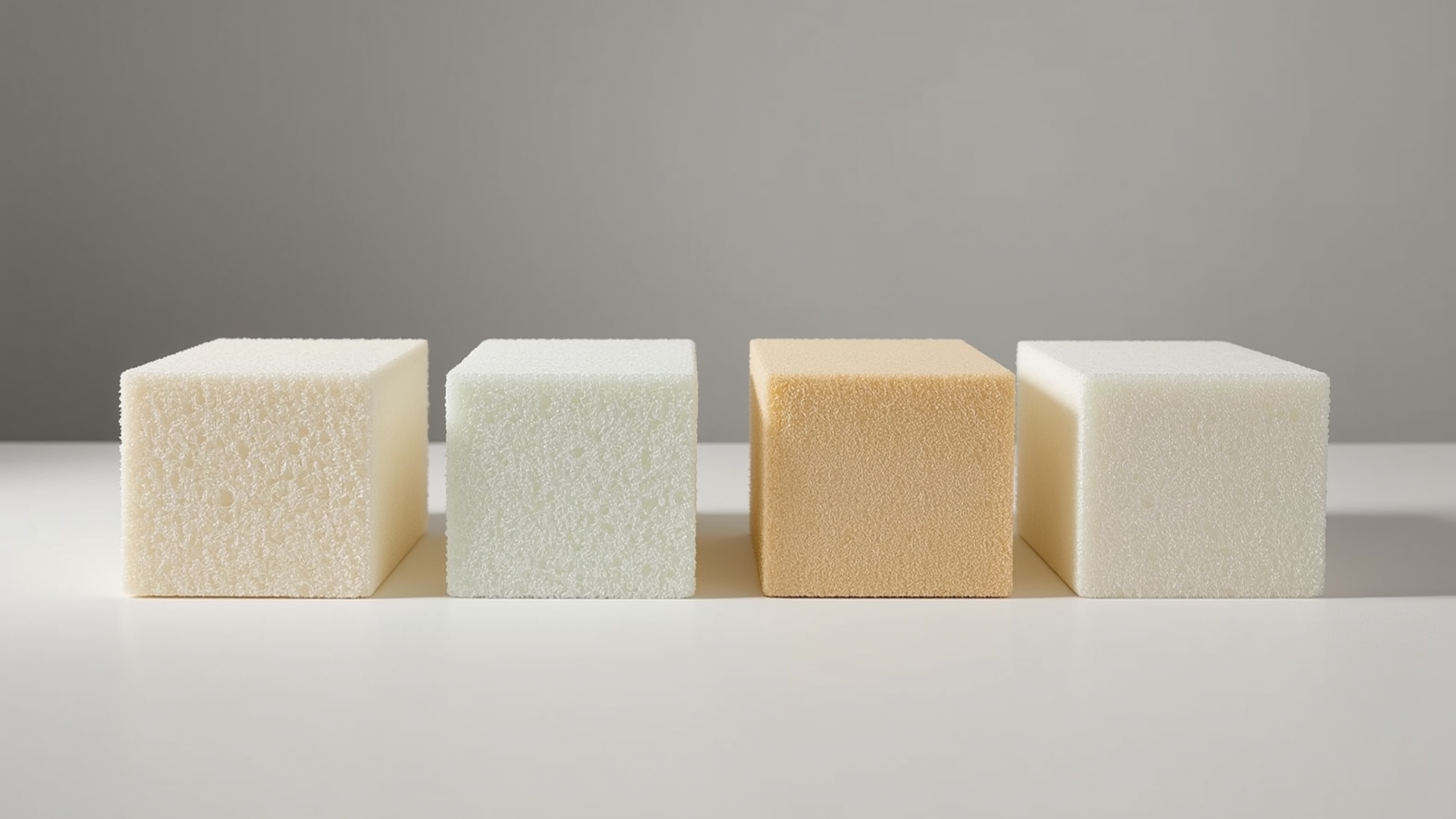
Quick Answer: Sofa foam comes in four practical grades: low (under 1.5 lb/ft³), standard (1.5 to 1.8), high (1.8 to 2.2), and premium (2.2 to 2.8+). Daily-use sofas need at least 1.8 lb/ft³ to last more than two to three years.
| Density Grade | Density Range (lb/ft³) | Expected Lifespan | Best Use Case | Typical Price Tier |
|---|---|---|---|---|
| Low | Under 1.5 | 1 to 2 years | Occasional-use furniture, guest rooms | Budget (under $600) |
| Standard | 1.5 to 1.8 | 2 to 4 years | Light daily use | Mid-range ($600 to $1,200) |
| High | 1.8 to 2.2 | 5 to 8 years | Daily family use | Mid to upper ($1,200 to $2,500) |
| Premium | 2.2 to 2.8+ | 8 to 15 years | Heavy daily use, commercial settings | Upper to luxury ($2,500+) |
Low-Density Foam (Under 1.5 lb/ft³)
This is the foam you find in most big-box store sofas under $600. It feels soft when new but breaks down within one to two years of regular use. The cells collapse and the cushion stops bouncing back.
Low-density foam is fine for a guest room sofa that gets used a few times a year. For a living room sofa that gets daily use, it’s a poor investment.
Standard-Density Foam (1.5 to 1.8 lb/ft³)
Standard foam lasts two to four years with daily use. It’s common in mid-range sofas and provides acceptable short-term comfort. The cushions will eventually flatten, but not as quickly as low-density foam.
If you’re furnishing a space on a short-term budget, or expect to redecorate in a few years, standard density is workable.
High-Density Foam (1.8 to 2.2 lb/ft³)
This is the sweet spot for most households. High-density foam at 1.8 to 2.2 lb/ft³ holds its shape through five to eight years of regular daily use. It’s firm enough to support your body and dense enough to recover between uses.
Most quality furniture brands use foam in this range as their base cushion core.
Premium-Density Foam (2.2 lb/ft³ and Above)
Premium foam is used in contract furniture (hotels, offices) and high-end residential pieces. It can last 10 to 15 years under heavy use. The tradeoff is cost — premium foam significantly raises the price of a sofa.
For most homeowners, premium foam is worth it in pieces you plan to keep for a decade or more.
What Is ILD Rating and How Is It Different From Density?
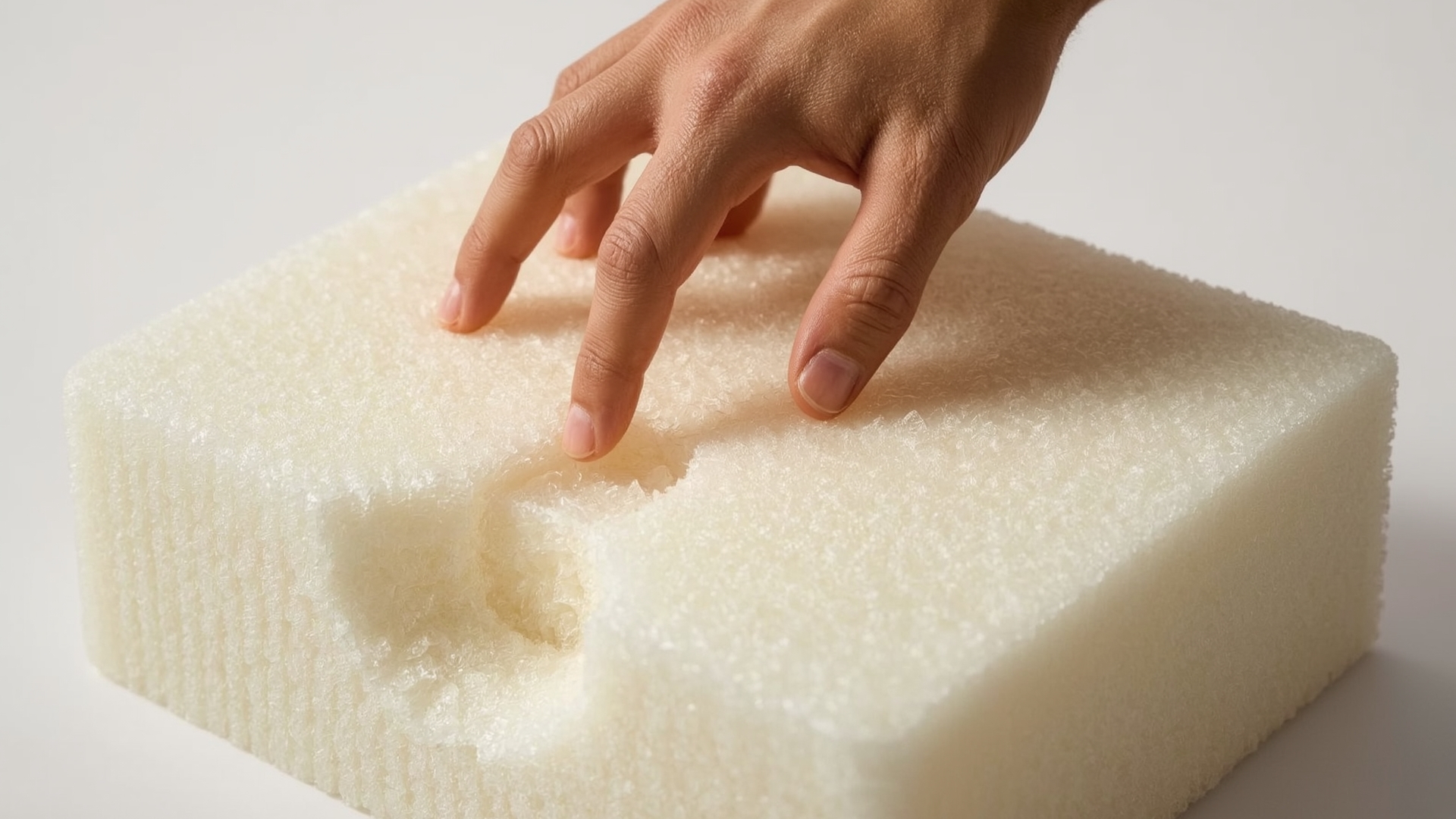
Quick Answer: ILD (Indentation Load Deflection) measures firmness, not durability. It’s the force in pounds needed to compress a 4-inch foam slab by 25%. Soft cushions run 15 to 20 ILD. Firm cushions run 35 to 45 ILD. Density and ILD are completely independent specs.
ILD stands for Indentation Load Deflection. It’s the industry standard test for measuring how firm a foam feels.
Here’s how the test works: a machine presses a circular plate into a 4-inch thick foam slab until it compresses 25%. The pounds of force required to reach that point is the ILD number. A 15 ILD foam requires 15 pounds of force. A 40 ILD foam requires 40 pounds.
ILD Ranges and What They Feel Like
| ILD Range | Perceived Firmness | Common Application | Suitable Sleeper Weight |
|---|---|---|---|
| 10 to 15 ILD | Very soft | Back cushions, decorative pillows | Under 130 lbs |
| 16 to 22 ILD | Soft | Plush seat cushions | 130 to 160 lbs |
| 23 to 30 ILD | Medium | Standard seat cushions | 160 to 210 lbs |
| 31 to 40 ILD | Firm | Heavy-use seat cushions | 210 to 280 lbs |
| 41 to 50 ILD | Extra firm | Commercial seating, sofa beds | 280+ lbs |
Why Density and ILD Must Both Be Considered
This is where a lot of buyers get confused. You can have a 1.5 lb/ft³ foam with a 40 ILD rating. It feels very firm. But it will still break down quickly because the density is low.
Conversely, a 2.5 lb/ft³ foam at 18 ILD will feel soft and plush but last for years because the density is high enough to support long-term use.
Always ask for both numbers. Firmness tells you how a cushion feels today. Density tells you how long it will last.
What Is High-Resilience Foam and Is It Worth the Extra Cost?
Quick Answer: High-resilience (HR) foam has an open-cell structure that lets air move freely, so the foam springs back faster after compression. It outperforms standard foam at the same density and typically costs 20 to 40 percent more per cushion.
High-resilience foam, often abbreviated as HR foam, is a different manufacturing process than standard polyurethane foam. The cell structure is more open, which means air flows in and out more freely when you sit down and stand up.
This open-cell structure gives HR foam two key advantages. First, it recovers its shape faster. Second, it maintains that recovery rate for longer because the cells resist breakdown more effectively.
HR Foam vs. Standard Polyurethane Foam
| Property | Standard Polyurethane Foam | High-Resilience (HR) Foam |
|---|---|---|
| Cell Structure | Closed or mixed cells | Open cells |
| Recovery Speed | 2 to 5 seconds | Under 1 second |
| Typical Density Range | 1.2 to 2.5 lb/ft³ | 1.8 to 3.0 lb/ft³ |
| Lifespan at 2.0 lb/ft³ | 4 to 6 years | 7 to 10 years |
| Cost Premium vs. Standard | Baseline | 20 to 40% higher |
| Heat Retention | Moderate | Low (breathes better) |
HR foam is the right choice if you’re buying a sofa you plan to keep for 10+ years. The cost premium is front-loaded, but the extended lifespan makes it cheaper over time than replacing standard foam every four to five years.
How Do Cushion Fill Types Affect Foam Performance?
Quick Answer: Most sofas use foam as a core with a wraparound layer of fiber, down, or down-blend. The foam core determines durability. The outer fill determines feel. A low-density foam core wrapped in down will feel luxurious but still fail within two to three years.
The cushion fill type is the combination of materials that make up a sofa cushion from the inside out. Most cushions aren’t made of a single material. They’re built in layers.
Foam-Only Cushions
Foam-only cushions use a single foam block inside a fabric casing. They hold their shape best, have the most predictable lifespan, and are the easiest to replace. The feel ranges from firm to medium depending on the ILD rating.
This construction is common in contract furniture and performance-focused residential pieces.
Foam Core with Fiber Wrap
A fiber-wrapped foam core adds a layer of polyester fiberfill around the foam block before it goes into the cushion casing. This softens the edges and gives the cushion a less boxy, more relaxed appearance.
The fiber wrap compresses over time and can make cushions look saggy even when the foam core is still intact. Refilling or replacing the fiber wrap is inexpensive and can extend the feel of the cushion without replacing the core.
Foam Core with Down-Blend Wrap
Down-blend wraps replace the polyester fiber with a mix of down feathers and feather clusters. This creates a noticeably softer, more luxurious feel. Down-blend cushions require regular fluffing to redistribute the fill and prevent uneven compression.
Down-blend wraps are common in upper mid-range and luxury sofas. They pair best with high-density foam cores (2.0 lb/ft³ or above) to prevent premature sagging.
Cushion Fill Types at a Glance
| Fill Type | Comfort Feel | Maintenance Need | Lifespan (with HR foam core) | Relative Cost |
|---|---|---|---|---|
| Foam only | Firm to medium | Very low | 7 to 12 years | Low to mid |
| Foam + polyester fiber wrap | Soft with structure | Low (occasional refluff) | 6 to 10 years | Mid |
| Foam + down-blend wrap | Plush, luxurious | Medium (regular fluffing) | 8 to 12 years | Mid to high |
| Pure down (no foam core) | Very soft, loose | High (daily fluffing) | 5 to 8 years | High |
What Foam Density Should You Look for Based on How You Use Your Sofa?
Quick Answer: For daily family use, look for 1.8 to 2.2 lb/ft³ foam with a 25 to 35 ILD firmness. Households with pets or children should target 2.0 lb/ft³ minimum. Occasional-use sofas can go as low as 1.5 lb/ft³ without rapid deterioration.
Daily Living Room Use (Family of 3 to 5)
A family sofa gets heavy use. Kids, pets, and regular evening sitting all accelerate foam breakdown. You want a minimum of 2.0 lb/ft³ density with HR foam if the budget allows. A 25 to 32 ILD firmness will feel comfortable for most adults and hold up to active use.
Home Office or Reading Sofa
A sofa used for reading, remote work, or individual relaxation sees moderate but focused use. The same person sits in the same spot repeatedly, which creates localized compression in the foam. A density of 1.8 to 2.0 lb/ft³ is appropriate, and selecting a firmer ILD (30 to 38) helps resist localized denting.
Guest Room or Occasional-Use Sofa
A sofa used fewer than three times per week can handle 1.5 to 1.8 lb/ft³ foam without significant early degradation. Standard foam is cost-effective here because the compression cycles are low.
Sofa Bed (Sleeper Sofa)
Sleeper sofas take abuse from two directions: sitting compression and sleeping compression. Foam density matters even more here. Target 2.2 lb/ft³ or higher with an ILD of 35 to 45 for the seat cushions. The pull-out mattress is a separate component with its own specs.
How Can You Tell If a Sofa Has Good Foam Without Seeing the Spec Sheet?

Quick Answer: Press firmly in the center of a seat cushion and hold for five seconds. High-density foam rebounds in under two seconds. Low-density foam stays compressed or rebounds slowly. Check cushion corners — rounded, saggy corners on a new sofa signal low-density fill.
The Rebound Test
Press your palm firmly into the seat cushion and hold it for five full seconds. Release your hand and watch what happens. High-density foam (1.8 lb/ft³ and above) springs back within one to two seconds. Low-density foam takes three to five seconds or stays partially compressed.
This test isn’t perfect, but it’s the fastest way to assess foam quality without a spec sheet.
The Corner Check
Look at the edges and corners of the seat cushions on a brand-new sofa. High-quality foam holds sharp, defined corners. Low-density foam often shows rounded or slightly saggy corners even when new, because it was compressed during shipping and didn’t fully recover.
The Weight Test
Lift a seat cushion out of its case if the sofa allows removable cushions. A high-density foam cushion is noticeably heavier than a low-density one of the same size. This is a reliable proxy test when you don’t have the spec sheet.
Ask the Right Question
When a salesperson says a sofa has “high-quality foam” or “premium fill,” ask for the specific density number in pounds per cubic foot. If they can’t answer, that’s meaningful information.
How Long Do Sofa Cushions Last at Different Foam Densities?
Quick Answer: Sofa cushion lifespan ranges from 1 to 2 years at low density (under 1.5 lb/ft³) to 10 to 15 years at premium density (2.5 lb/ft³ and above). Usage frequency, body weight, and cushion rotation practices all affect actual lifespan.
The lifespan estimates below assume daily use on a sofa used by two adults, roughly four to six hours per day.
| Foam Density | Foam Type | ILD Range | Expected Lifespan (Daily Use) | Signs of Failure |
|---|---|---|---|---|
| Under 1.5 lb/ft³ | Standard polyurethane | 15 to 25 | 1 to 2 years | Bottoming out, permanent indentations |
| 1.5 to 1.8 lb/ft³ | Standard polyurethane | 20 to 30 | 2 to 4 years | Uneven surface, slower rebound |
| 1.8 to 2.2 lb/ft³ | Standard or HR | 25 to 38 | 5 to 8 years | Slight softening, corners lose definition |
| 2.2 to 2.8 lb/ft³ | HR foam | 28 to 45 | 8 to 12 years | Gradual softening only, no structural failure |
| 2.8+ lb/ft³ | HR foam, commercial grade | 35 to 50 | 12 to 15+ years | Fabric wears out before foam fails |
Does Rotating Cushions Extend Foam Life?
Yes. Rotating and flipping cushions (on reversible designs) distributes compression across more of the foam surface. This can extend useful life by 20 to 30 percent.
Even with non-reversible cushions, rotating the left and right seat positions every two to three months prevents one spot from wearing faster than the others.
Can You Replace Sofa Foam Without Buying a New Sofa?
Quick Answer: Yes. Sofa foam is replaceable on most removable-cushion designs. Replacement foam is sold by the sheet or custom-cut to size. A full set of seat cushion foam cores typically costs $80 to $300 depending on foam grade and cushion count.
Replacing sofa foam is one of the most cost-effective ways to restore a structurally sound sofa. If the frame and fabric are still in good shape, new foam cores can feel like buying a new sofa for a fraction of the cost.
How to Order Replacement Foam
Measure each cushion casing precisely: length, width, and height in inches. When ordering, size the foam about half an inch larger than your measurements in all directions. Foam compresses to fill the casing and this slight oversize prevents a loose, saggy fit.
Order foam at 2.0 lb/ft³ or higher when replacing worn-out cushions. Upgrading to a higher density than the original foam is a straightforward way to get a better sofa than you originally bought.
Foam Replacement Cost by Grade
Standard polyurethane foam sheets cost roughly $20 to $40 per cubic foot. High-resilience foam runs $35 to $70 per cubic foot. A three-seat sofa with three cushions typically requires two to four cubic feet of foam total, putting full replacement at $60 to $280 for materials.
Is Memory Foam a Good Choice for Sofa Cushions?
Quick Answer: Memory foam is rarely used as a primary sofa cushion material. It responds to heat and compresses slowly, which creates a “stuck” feeling. It’s sometimes layered as a 1 to 2 inch topper over a high-density foam core for added pressure relief.
Memory foam works well in mattresses because you stay in one position for hours. Sofa use involves frequent position changes, standing up, and sitting down repeatedly. Memory foam’s slow response rate is a drawback in that context.
If you see memory foam mentioned in sofa specs, look for how it’s used. A thin comfort layer over a high-density base is fine. Memory foam as the primary cushion core is not ideal for most users.
What Other Foam Specs Should You Check When Buying a Sofa?
Quick Answer: Beyond density and ILD, check for CertiPUR-US certification (confirms no harmful chemicals), compression set percentage (lower is better — under 15% is good), and whether the foam is virgin foam or recycled rebond foam, which performs differently.
CertiPUR-US Certification
CertiPUR-US is a voluntary certification program for polyurethane foam. It tests for harmful substances including heavy metals, formaldehyde, and certain flame retardants. Certified foam must also meet durability standards.
Look for this certification especially if you have children or chemical sensitivities. It’s a meaningful signal that the foam manufacturer has passed third-party testing.
Compression Set Percentage
Compression set measures how much a foam permanently deforms after repeated compression. A compression set of 10% means the foam permanently lost 10% of its original height after extended use. Lower numbers are better. Quality foams test at 10 to 15% compression set. Low-grade foams can exceed 25%.
Virgin Foam vs. Rebond Foam
Virgin foam is manufactured from new materials in a single consistent batch. Rebond foam, sometimes called bonded foam, is made from shredded foam scraps compressed and bonded together with adhesive. Rebond foam is cheaper and denser by weight but has an inconsistent feel and breaks down unevenly.
Rebond foam is commonly used in carpet underlays, not quality sofa cushions. If it appears in sofa specs, treat it as a low-quality signal.
Frequently Asked Questions
What foam density is considered good for a sofa?
For daily use, 1.8 lb/ft³ is the minimum worth buying. Most furniture professionals recommend 2.0 to 2.2 lb/ft³ for living room sofas that get regular use. High-resilience foam at these densities will last five to eight years or more with basic care.
Does higher density foam always mean a firmer cushion?
No. Density and firmness are separate properties. Density measures the amount of foam material per cubic foot. Firmness is measured by ILD rating. A high-density foam can be manufactured to any ILD level, from very soft to very firm.
How do I know if my sofa foam needs replacing?
Three signs indicate foam failure: the cushion bottoms out when you sit (you can feel the base through the cushion), the surface shows permanent indentations that don’t recover, or the cushion height has noticeably dropped compared to when the sofa was new.
What is the best foam density for a sofa bed?
Sofa beds need higher density foam than standard sofas because they handle both sitting and sleeping compression. Target 2.2 lb/ft³ or higher with a 35 to 45 ILD firmness for seat cushions. The pull-out mattress is a separate unit and has its own foam or spring system.
Is a down-wrapped cushion better than foam-only?
Better is subjective here. Down-blend wraps feel softer and more luxurious. Foam-only cushions hold their shape longer with less maintenance. Most quality sofas use a foam core with a down-blend or fiber wrap to get both structure and comfort in the same cushion.
Can cheap foam in a sofa be an off-gassing risk?
Low-grade polyurethane foam can release volatile organic compounds (VOCs), which are chemical gases, especially when new. This is more common in foam without third-party certification. Looking for CertiPUR-US certified foam reduces this risk significantly. Off-gassing typically fades within a few weeks in a ventilated room.
