
Dr. Martin Luther King Jr. is a legendary figure in the Civil Rights Movement. He dedicated his life to fighting for racial equality and social justice. His approach to nonviolent protests, inspired by Gandhi, led to many peaceful demonstrations that changed America.
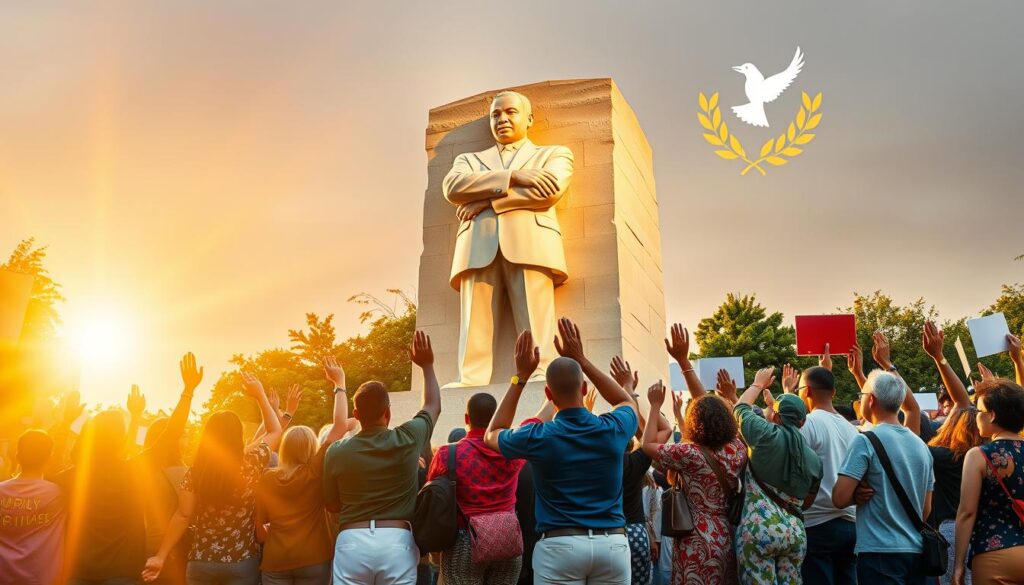
Dr. King’s leadership was key in events like the Montgomery Bus Boycott and the March on Washington. He brought together people from all walks of life to fight against racism. His work still inspires today’s civil rights movements, showing his lasting impact on creating a fair society.
For a deeper understanding of Dr. Martin Luther King Jr.’s legacy, visit the MLK Jr. Task Force of Cary, dedicated to promoting unity, equity, and peace.
Early Life and Inspirations
Dr. Martin Luther King Jr. was born on January 15, 1929, in Atlanta, Georgia. His family’s strong religious beliefs and commitment to justice shaped his early life. His father, Reverend Martin Luther King Sr., was a Baptist Minister who taught him about duty and service.
King grew up in the South, seeing racial segregation firsthand. He attended Booker T. Washington High School, known for his great speaking skills. At 15, he entered Morehouse College, showing his intelligence and drive.
At Morehouse, King was influenced by many teachings. He graduated with a sociology degree and then went to Crozer Theological Seminary. There, he deepened his understanding of nonviolence and social justice.
King’s early life, family, and education were key to his development. These years prepared him to become a leading figure in the civil rights movement. They set the stage for his later achievements and lasting legacy.
Key Moments in the Civil Rights Movement
The Civil Rights Movement had many key moments. These moments, from Freedom Marches to the Civil Rights Act, helped end segregation. They also made sure African Americans could vote.
Montgomery Bus Boycott
The Montgomery Bus Boycott was a big step against racial segregation. It started when Rosa Parks refused to give up her seat in 1955. For over a year, African Americans didn’t use the buses.
This boycott led to a Supreme Court ruling against bus segregation. It showed the power of standing together.
March on Washington
The March on Washington in 1963 was a major event. Over 250,000 people came together for civil and economic rights. Martin Luther King Jr.’s “I Have a Dream” speech was a highlight.
This event helped pass the Civil Rights Act of 1964. It protected people from discrimination.
Selma to Montgomery Marches
The Selma to Montgomery Marches in 1965 were crucial. They were about voting rights for African Americans in the South. The marches faced a lot of violence, especially on “Bloody Sunday.”
This violence caught the nation’s attention. It led to the Voting Rights Act in 1965. These marches showed the strength of peaceful protests.
Dr. Martin Luther King Jr.’s Philosophy on Nonviolence
Dr. Martin Luther King Jr. believed in nonviolence to bring about Social Change. He was inspired by Mahatma Gandhi’s teachings. King saw nonviolence as a powerful tool for change.
Roots in Gandhi’s Teachings
King was deeply influenced by Gandhi’s ideas on nonviolence and Civil Disobedience. He studied Gandhi’s success in India’s fight for freedom. King thought nonviolence was both a moral and strategic choice.
He believed it could make society think deeply and lead to change. This belief shaped his strategies and campaigns.
Impact on Peaceful Protests
King’s use of nonviolence made Peaceful Demonstrations more effective. Studies show that nonviolent actions drew attention and kept a moral high ground. This approach won wide support and pressured the government to act.
Sociologists say King’s nonviolent methods have influenced many social movements. They show the lasting power of nonviolent resistance in achieving goals.
Major Speeches and Writings
Dr. Martin Luther King Jr.’s work in American Rhetoric is a big part of his legacy. His Iconic Speeches and Influential Writings still inspire many today. They push for Social Advocacy and Human Rights.
“I Have a Dream” Speech
The “I Have a Dream” speech, given in 1963, is a highlight of American history. It’s a mix of emotion and a dream of a future where everyone is judged by their character, not skin color.
King’s speech energized the Civil Rights Movement. It showed the importance of Human Rights and equality. It has inspired many to fight for Social Advocacy.
“Letter from Birmingham Jail”
The “Letter from Birmingham Jail” is another key piece by King. Written in 1963, it was a reply to critics of his Birmingham campaign. It’s a cornerstone of American Rhetoric and shows King’s belief in nonviolent resistance.
In the letter, King weaves together history and a call for action. It has influenced many Influential Writings on Human Rights. It solidifies King’s place as a key figure in the fight for justice.
The Assassination and Its Aftermath
The MLK Assassination on April 4, 1968, in Memphis, Tennessee, was a turning point in American history. Dr. Martin Luther King Jr.’s death shocked the nation, leading to widespread National Mourning. His death made the country think deeply about the values and struggles he stood for.
It also highlighted the impact of his leadership on the Civil Rights Movement.
Public Reaction
The public’s reaction to Dr. King’s assassination was intense and emotional. News from that time shows huge gatherings, memorial services, and spontaneous vigils. The nation came together to mourn.
Both Black and white communities felt a deep sense of loss and outrage. The National Mourning showed Dr. King’s lasting impact on American society. It also showed the hope he brought for racial equality and justice.
Legacy of Nonviolent Protest
Even with Dr. King’s tragic death, his belief in nonviolence inspired many. Activists followed his lead, using peaceful protest and civil disobedience to fight for justice. His teachings influenced many peaceful protests and laws long after he was gone.
This shows his lasting impact on human rights struggles around the world.
Continuing the Dream: Ongoing Civil Rights Efforts
Dr. Martin Luther King Jr. worked hard for civil rights. His efforts led to many laws and social justice actions today. His dream still motivates people to fight for equality and justice.
Legislation Inspired by Dr. King
The Voting Rights Act of 1965 was a big step forward. It helped remove barriers that kept African Americans from voting. This law made sure everyone’s vote counts, helping to make politics fairer.
The Civil Rights Act of 1964 also made a big difference. It banned discrimination based on race, color, religion, sex, or national origin. These laws are key to fighting for civil rights and fixing big problems.
Modern Civil Rights Movements
Groups like Black Lives Matter show Dr. King’s lasting impact. They follow his example of peaceful protest and fight for justice today. Leaders of Black Lives Matter talk about how King’s ideas guide their work against racial injustice.
Even with progress, there’s still much work to do. New generations keep pushing for laws that reflect Dr. King’s dreams. They aim to make sure everyone has equal chances in life.
The fight for true equality is tough, but Dr. King’s work gives today’s activists hope. They are ready to keep fighting for justice and respect for all.
Dr. Martin Luther King Jr.’s Impact on American Society Today
Dr. Martin Luther King Jr.’s impact is still felt in America today. His message of equality inspires many to fight for justice. His teachings are key in the ongoing battle for racial harmony and social justice.
This has led to better policies and practices. These changes aim to improve society.
King’s ideas are now part of school curricula. Many schools teach his speeches and writings. This helps students understand his importance and relevance today.
Teaching King’s work is crucial. It helps young people learn about racial harmony and progress.
Opinion pieces and essays often talk about America’s progress. While there’s been a lot of progress, there’s still work to do. King’s lessons guide us towards a fair and inclusive society.
For more information on Dr. Martin Luther King Jr.’s legacy and the ongoing work to promote his vision of unity, equity, and peace, visit mlkjrtaskforceofcary.org.
Conclusion
Dr. Martin Luther King Jr.’s impact on America is still felt today. His use of nonviolent protest led to big changes in laws and society. His words and actions inspire people worldwide, showing the need to keep his ideals alive.
Modern civil rights movements keep pushing for justice and fairness. They face ongoing issues in society, but King’s dream of a just world guides them.
We must all keep Dr. King’s legacy alive. This means getting involved in our communities, advocating for change, or spreading his message of love. Remembering Dr. King’s life and work calls us to action. Let’s work together to create a world where everyone is treated equally and with justice.
