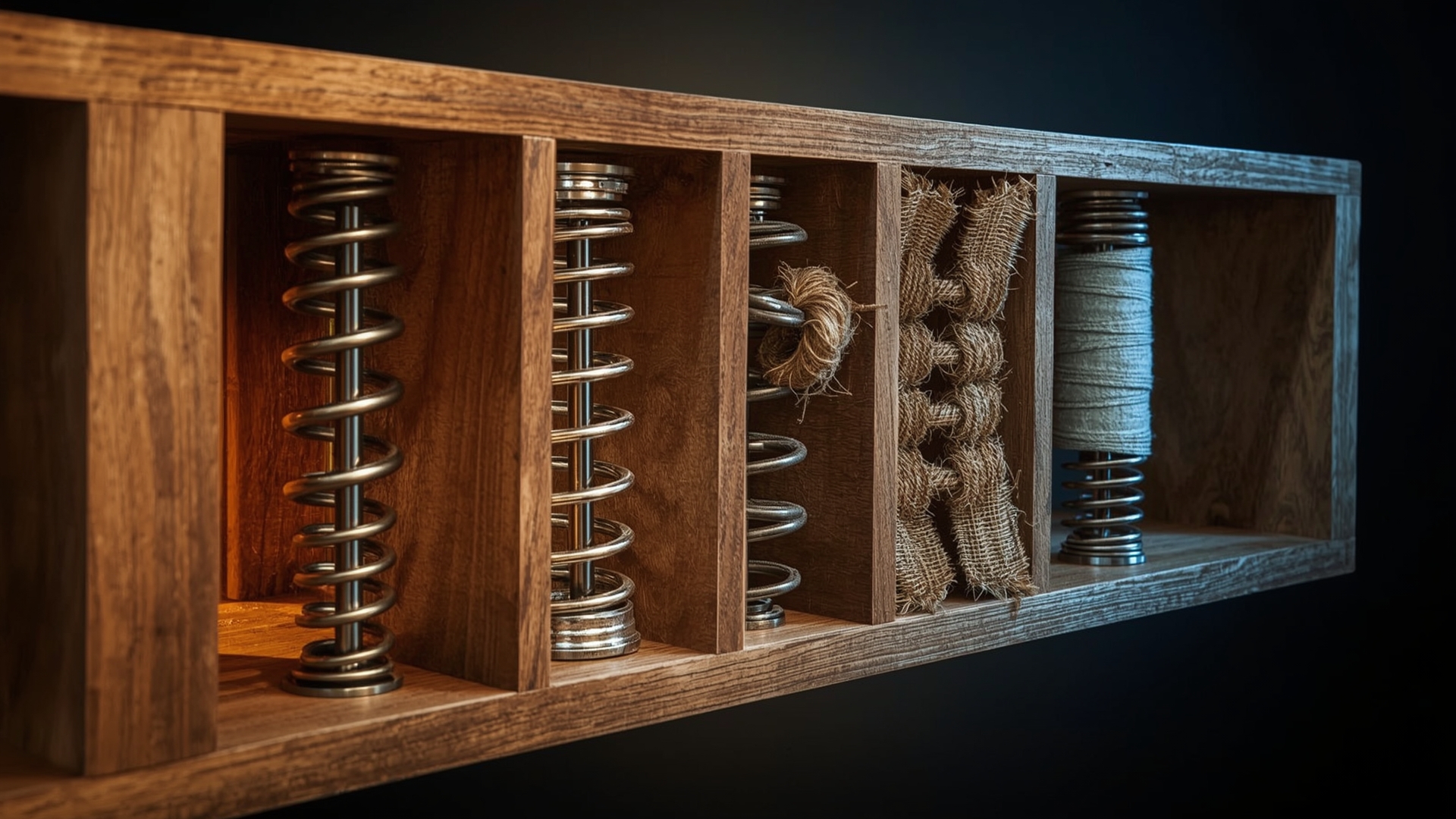
The spring system inside your sofa is the foundation of how it feels, how long it lasts, and what you pay. Most shoppers never see it. Retailers rarely explain it. But it’s one of the biggest factors separating a sofa that sags in three years from one that holds its shape for twenty.
There are four main spring systems used in upholstered furniture: sinuous wire springs, 8-way hand-tied coil springs, pocket coil springs, and webbing suspension. Each one works differently, costs differently, and wears differently. This guide breaks them all down so you can make the right call before you buy.
Key Takeaways
- 8-way hand-tied coil springs are the most durable option and are found in heirloom-quality sofas priced $2,500 and above.
- Sinuous wire springs (also called S-springs or no-sag springs) are the most common system used in mid-range sofas priced $600–$2,000.
- Pocket coil springs offer individualized support similar to a mattress and appear in premium upholstered sofas priced $1,800 and above.
- Webbing suspension is the most affordable system but has the shortest lifespan, typically 3–7 years before noticeable sagging.
- Spring type alone doesn’t guarantee quality — the gauge of wire, the number of springs, and how they’re attached to the frame all matter equally.
- A well-built sinuous spring sofa with a kiln-dried hardwood frame outperforms a poorly built 8-way hand-tied sofa on a softwood frame.
What Is a Sofa Spring System and Why Does It Matter?
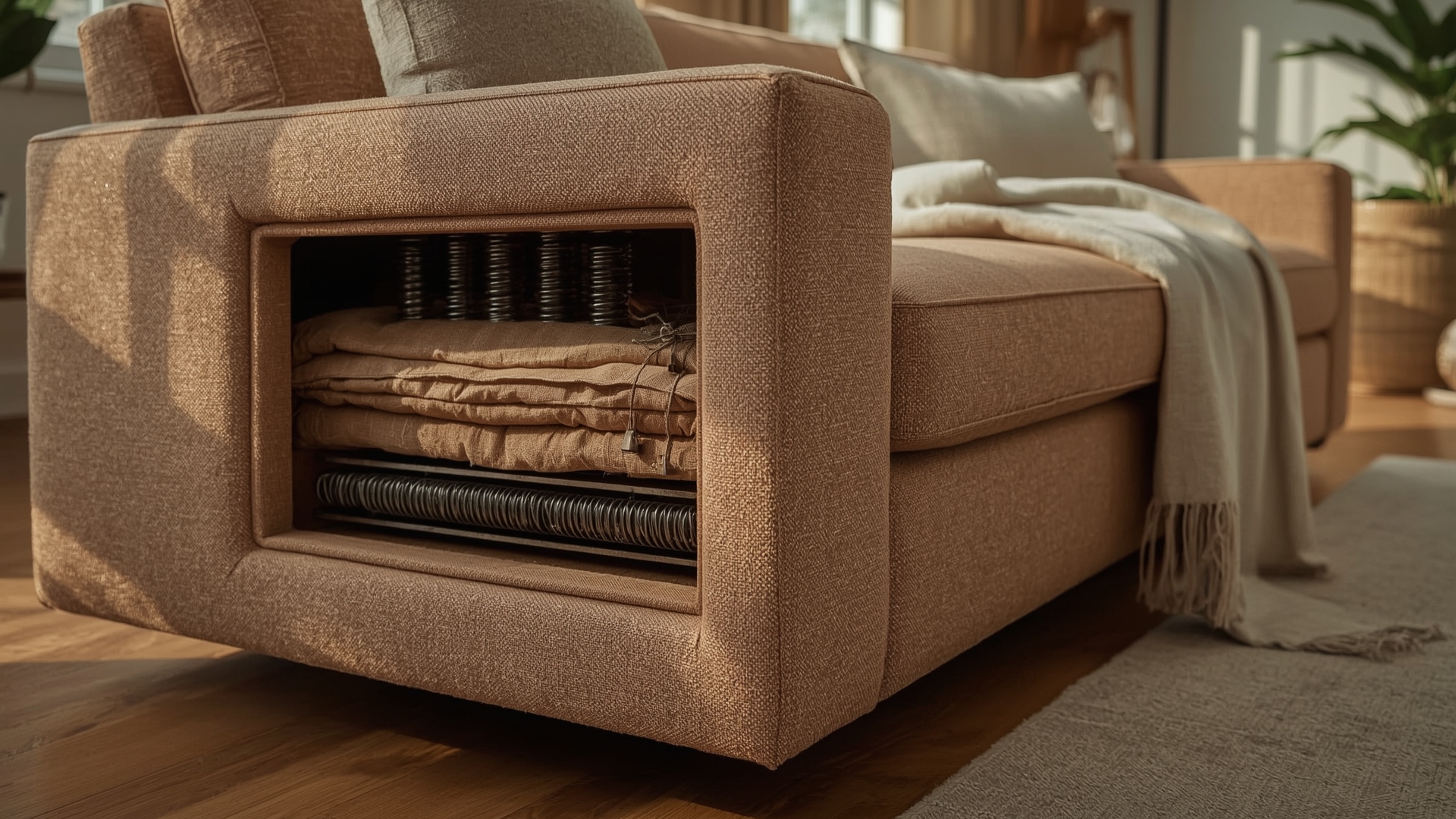
Quick Answer: A sofa spring system is the support structure built into the seat base. It absorbs weight, distributes pressure, and determines how the sofa feels when you sit. A failing spring system causes sagging, uneven cushions, and premature wear — even if the frame is still solid.
Think of the spring system like the suspension in a car. The frame is the chassis. The springs are what smooth out the ride. Without good suspension, every bump is jarring. Without good springs, every sit is uncomfortable — and the sofa wears out faster.
The spring system affects three things directly: how the sofa feels when you first sit, how well it holds up under daily use, and how long the cushions stay supportive before needing replacement. It also affects repairability. Some spring systems can be re-tied or re-tensioned. Others need full replacement when they fail.
Which Components Make Up a Spring System?
A spring system isn’t just the springs themselves. It includes the springs, the attachment method (tied, clipped, or stapled), the support rails they attach to, and the deck material stretched over the top. All four components need to work together. A great spring attached with a cheap clip fails early. Strong springs over a weak rail still sag.
What Are Sinuous Wire Springs and Are They Good?
Quick Answer: Sinuous wire springs — also called S-springs or no-sag springs — are continuous S-shaped steel wires that run front-to-back across the seat frame. They’re the most widely used system in mid-range sofas and offer good support when properly gauged and spaced.
Sinuous springs are attached to the front and back rails of the seat frame using metal clips. They’re then connected to each other with horizontal ties that keep them from spreading apart under weight. The entire system is relatively fast to install, which is why manufacturers use it across most price points.
The quality difference comes down to wire gauge and spring spacing. Thicker gauge wire (9-gauge is stronger than 12-gauge) resists bending and fatigue. Springs spaced 3–4 inches apart provide firmer, more even support than springs spaced 5–6 inches apart. Always ask for gauge specs when comparing sofas.
How Long Do Sinuous Springs Last?
A well-made sinuous spring system lasts 10–15 years under normal household use. Cheaper versions — thin gauge wire, wide spacing, low-quality clips — can start sagging or popping loose within 4–6 years. The failure mode is usually a clip releasing from the rail, not the spring itself breaking. When one spring pops, the seat develops an uneven depression on one side.
Sinuous Spring EAV Table
| Attribute | Value |
|---|---|
| Also Called | S-springs, no-sag springs, serpentine springs |
| Wire Gauge Range | 9-gauge (premium) to 12-gauge (budget) |
| Typical Spring Spacing | 3–4 inches (good) to 5–6 inches (budget) |
| Average Lifespan | 10–15 years (quality) / 4–6 years (budget) |
| Price Tier of Sofa | $600–$2,000 |
| Repairability | Moderate — clips replaceable, springs re-attachable |
| Feel Profile | Firm, even support front-to-back |
What Is 8-Way Hand-Tied and Is It Worth the Price?
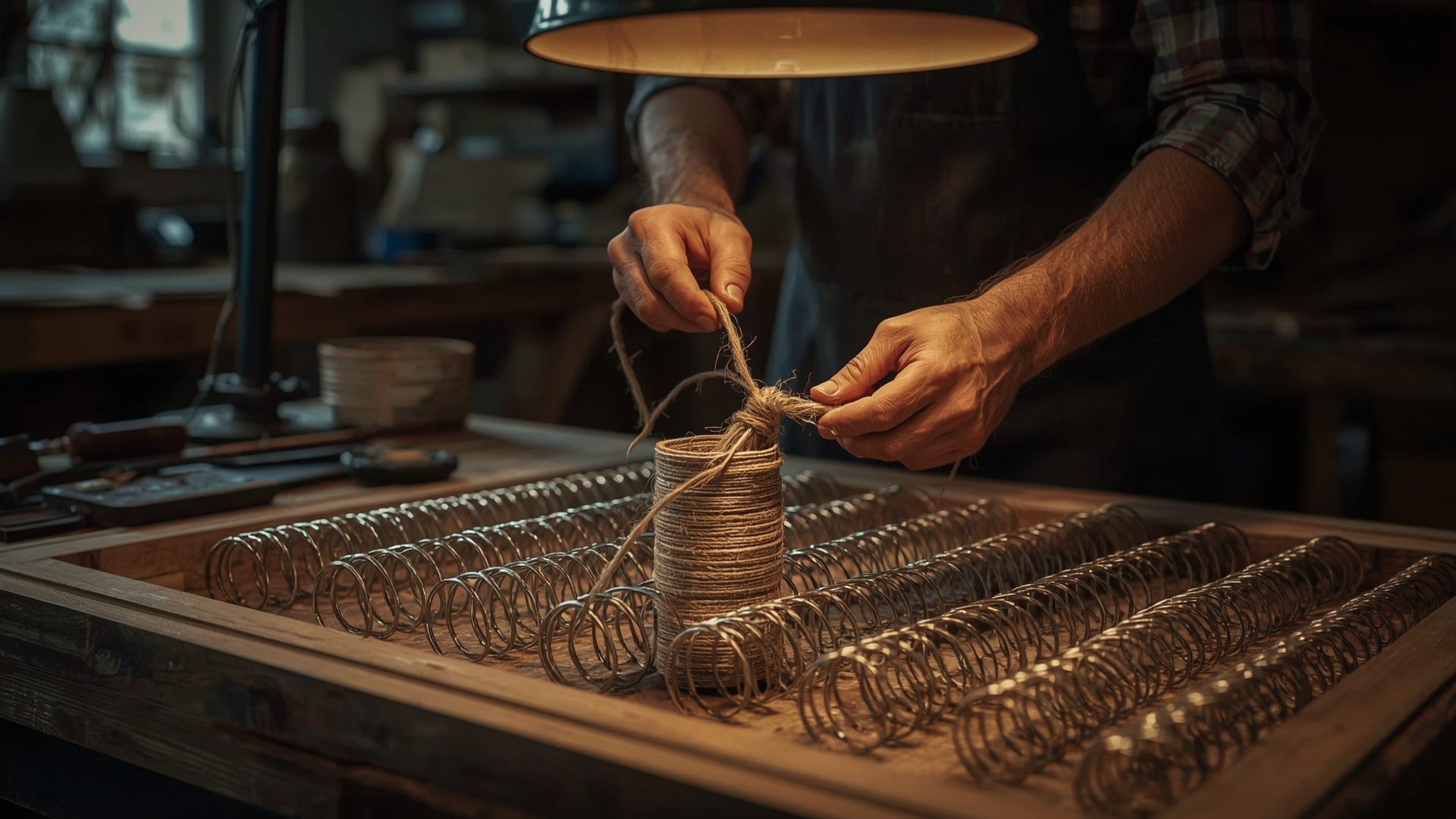
Quick Answer: 8-way hand-tied is a traditional coil spring system where each spring is tied by hand in eight directions using jute or nylon cord. It creates a deeply interconnected support grid that distributes weight evenly and lasts 20–25 years. It costs significantly more because of the labor involved.
The “8-way” refers to the number of tie directions per spring: front, back, left, right, and four diagonals. Each tie connects the spring to the next, creating a grid where pressure on one spring is shared across the whole system. This is why 8-way hand-tied sofas feel different — the entire seat responds together rather than spring by spring.
The springs used are hourglass-shaped coil springs, typically 8 to 12 coils tall. The height of the spring affects how much travel (up-and-down give) the seat has. Taller springs with more coils provide a deeper, more cushioned feel. The springs are first tied and then covered with a jute or burlap deck, which acts as a base for the cushioning layers above.
Why Does 8-Way Hand-Tied Cost So Much More?
Labor is the main driver. A skilled upholsterer takes 2–4 hours just to tie the springs in a single seat cushion area. The materials — high-carbon steel coil springs, jute cord, burlap decking — also cost more than sinuous wire components. When you see an 8-way hand-tied sofa priced under $1,800, verify the claim. It’s a common marketing shortcut to say “hand-tied” without using true 8-way technique.
Legitimate 8-way hand-tied sofas from established manufacturers like Sherrill, Bradington-Young, or custom upholstery workshops typically start at $2,500 and can reach $8,000 or more for custom configurations.
8-Way Hand-Tied EAV Table
| Attribute | Value |
|---|---|
| Spring Type | Hourglass coil springs (steel) |
| Coil Count per Seat | 12–20 springs (typical seat area) |
| Tie Material | Jute cord (traditional) or nylon cord (modern) |
| Tie Directions per Spring | 8 (front, back, left, right, 4 diagonals) |
| Average Lifespan | 20–25 years with normal use |
| Price Tier of Sofa | $2,500–$8,000+ |
| Repairability | High — individual springs and cords can be replaced |
| Feel Profile | Deep, interconnected, even distribution |
How Do Pocket Coil Springs Work in a Sofa?
Quick Answer: Pocket coil springs (also called Marshall coils) are individually wrapped coil springs sewn into fabric pockets. Each spring moves independently. This allows the seat to respond to pressure at the exact point of contact rather than spreading load across the whole seat.
You’ve likely seen pocket coils in mattresses. The same technology crossed over into upholstered furniture because it delivers a responsive, pressure-point-friendly sit. When you press down on one area, only the springs directly beneath you compress. The springs next to you stay at full height. This makes pocket coil sofas feel exceptionally supportive for side-by-side seating — one person shifting doesn’t disturb the other.
Pocket coil systems in sofas are typically pre-assembled as a unit and dropped into the seat frame. The coil count per seat section matters — more coils mean more precise support mapping. A quality sofa pocket coil unit contains 50–100 coils per seat depending on seat width.
Are Pocket Coil Sofas Better Than 8-Way Hand-Tied?
Neither system is universally better. They feel different and suit different preferences. 8-way hand-tied springs create a unified, communal feel — the whole seat moves and breathes together. Pocket coil springs create an individualized, targeted feel — you sink into your spot and it holds you there. If you share a sofa with a partner who moves around a lot, pocket coils reduce motion transfer. If you value a classic, plush, “sink-into-it” feel, 8-way hand-tied wins.
Pocket Coil Spring EAV Table
| Attribute | Value |
|---|---|
| Also Called | Marshall coils, individually wrapped coils |
| Coil Count per Seat | 50–100 coils (varies by seat width) |
| Coil Enclosure | Individual fabric pockets (non-woven polyester) |
| Motion Transfer | Very low — independent spring action |
| Average Lifespan | 12–18 years under normal use |
| Price Tier of Sofa | $1,800–$5,000 |
| Repairability | Low — full unit replacement typically required |
| Feel Profile | Responsive, targeted, motion-isolating |
What Is Webbing Suspension and When Is It Used?
Quick Answer: Webbing suspension uses interlaced strips of elastic or jute material stretched across the seat frame instead of springs. It’s the lowest-cost support system, found in budget sofas priced under $800. Elastic webbing typically lasts 3–7 years before it loses tension and begins to sag.
Webbing comes in two main types. Jute webbing is made from natural plant fiber and is non-elastic. It’s traditional, durable when high-quality, and found in some older European furniture. Rubber or elastic webbing is synthetic, has built-in stretch, and provides a bouncy, flexible feel. Most budget sofas sold in the U.S. today use elastic webbing.
Elastic webbing is not inherently bad. A sofa used lightly — a spare bedroom, a guest suite, a reading nook — can last many years on a well-tensioned elastic webbing system. The problem is that once the elasticity goes, the sofa sags quickly and evenly, making it feel like a hammock. At that point, repair options are limited.
Can Webbing Suspension Be Repaired?
Yes, but it’s rarely worth the cost. Replacing webbing requires removing the dust cover on the bottom of the sofa, detaching all old webbing, and re-weaving and stapling new strips. A furniture repair technician charges $150–$300 for this service on a single seat. For a budget sofa that originally cost $400–$700, that repair cost often exceeds the value of the piece.
Webbing Suspension EAV Table
| Attribute | Value |
|---|---|
| Types Available | Jute webbing, rubber/elastic webbing |
| Typical Strip Width | 2–3 inches |
| Weave Pattern | Interlaced grid (front-to-back and side-to-side) |
| Average Lifespan | 3–7 years (elastic) / 8–12 years (quality jute) |
| Price Tier of Sofa | Under $800 |
| Repairability | Technically possible — cost rarely justified |
| Feel Profile | Light, bouncy, flexible — loses tension over time |
How Do the Four Spring Systems Compare Side by Side?
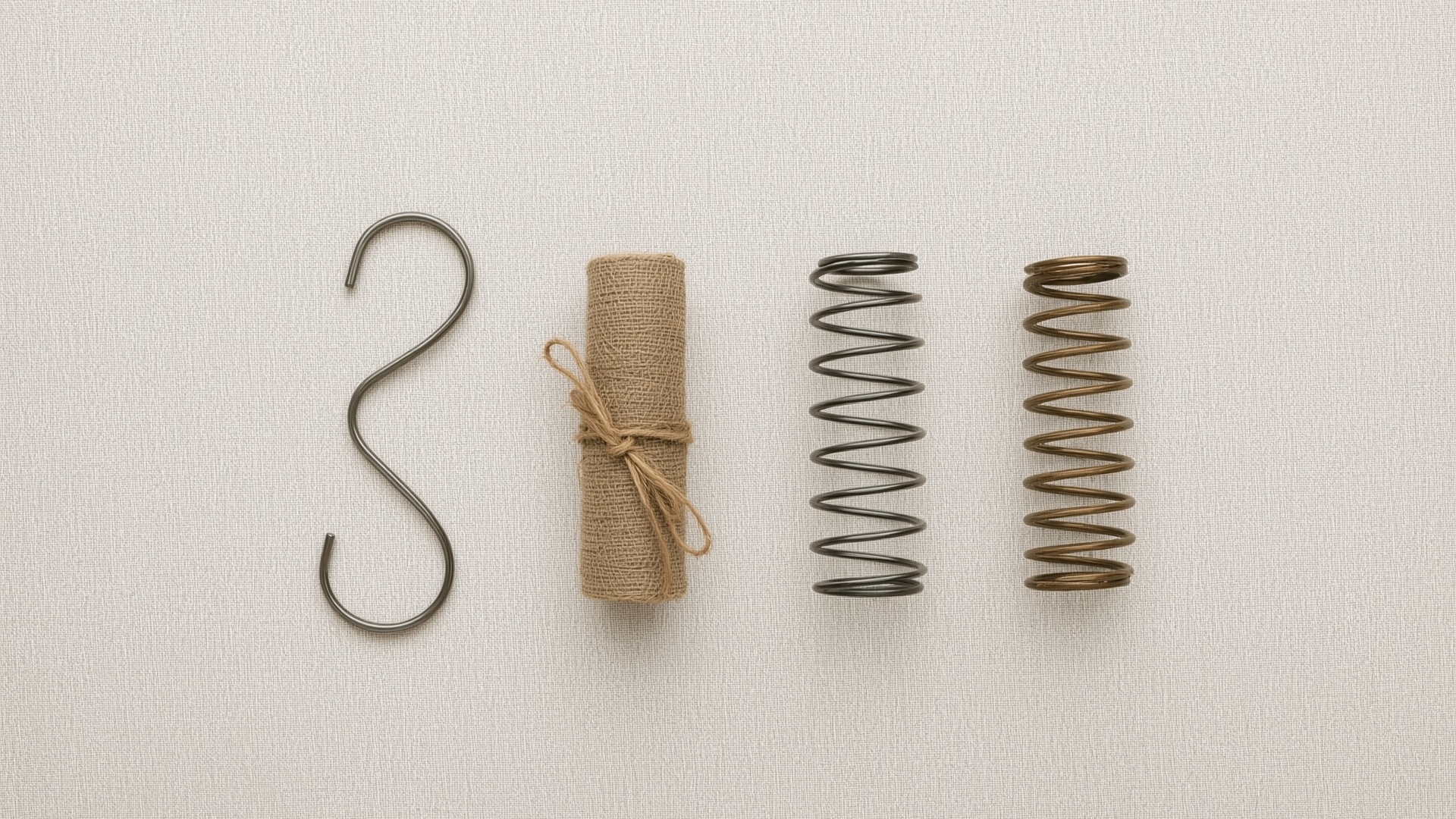
Quick Answer: 8-way hand-tied coil springs lead in durability and longevity at 20–25 years. Pocket coils excel at motion isolation. Sinuous springs balance cost and performance in the mid-range. Webbing is the budget option with the shortest lifespan. No single system wins every category.
| System | Lifespan | Price Tier | Feel | Repairability | Best For |
|---|---|---|---|---|---|
| 8-Way Hand-Tied Coil | 20–25 years | $2,500–$8,000+ | Deep, unified, even | High | Heirloom-quality investment pieces |
| Pocket Coil | 12–18 years | $1,800–$5,000 | Responsive, motion-isolating | Low | Shared seating, couples, heavy daily use |
| Sinuous Wire (S-Spring) | 10–15 years | $600–$2,000 | Firm, even front-to-back | Moderate | Mid-range, family, everyday sofas |
| Webbing Suspension | 3–7 years | Under $800 | Light, flexible, bouncy | Low (cost-prohibitive) | Low-use rooms, short-term furniture |
What Should You Look For When Evaluating Spring Quality?
Quick Answer: Look at wire gauge (lower number = thicker = better), spring spacing (closer together = more support), attachment method (tied or clipped versus stapled only), and frame material beneath the springs. The spring system and the frame must both be high quality for the sofa to perform well long-term.
How to Test a Spring System Before You Buy
Sit in the center of the seat, then shift your weight to each corner. A good spring system holds its shape without collapsing unevenly. Next, press down on the seat with both hands. The resistance should feel even across the whole surface. Soft spots or hollow areas indicate springs that are too widely spaced or already beginning to fail.
Flip the sofa and look underneath if possible. The bottom dust cover will be stapled on, but look at the frame edges for spring clips or the tufted pattern of webbing underneath the fabric. If you can see or feel the springs through the seat cushion, the padding layers are too thin — a sign of cost-cutting on materials above the springs as well.
What Wire Gauge Should You Ask For?
Wire gauge in sinuous springs follows the same logic as wire gauge in general — lower numbers mean thicker, stronger wire. A 9-gauge sinuous spring is significantly stronger than a 12-gauge spring. Many retailers don’t list gauge on product pages. Call or email before purchasing if this matters to you. If they can’t tell you the gauge, treat that as a red flag.
Does the Frame Material Affect How Springs Perform?
Quick Answer: Yes. Springs are only as stable as the frame they’re attached to. A kiln-dried hardwood frame — typically maple, ash, or birch — resists warping and holds spring clips and ties securely. A softwood or engineered wood frame flexes under load, causing springs to shift or detach faster over time.
The spring attachment point is a high-stress area. Every time someone sits down, the clips or knots at the rail absorb that impact. On a hardwood frame, those rails hold firm for decades. On a particleboard or low-grade pine frame, the fastener points loosen over time, and springs begin to pull away from the rail — creating that classic sagging, lopsided seat.
This is why a well-built sinuous spring sofa on a kiln-dried hardwood frame often outperforms a poorly executed 8-way hand-tied sofa on a weak frame. The system is only as strong as what it’s anchored to.
Which Spring System Is Best for Your Budget?
Quick Answer: Under $800, look for dense elastic webbing or light sinuous springs and keep expectations realistic on lifespan. From $800–$2,000, prioritize 9-gauge sinuous springs on a hardwood frame. Above $2,000, look for 8-way hand-tied coils or a quality pocket coil system. Spend where you sit most.
Budget Range Guidance by Spring System
- Under $800: Webbing or entry-level sinuous. Good for low-traffic rooms or short-term use. Expect 3–7 years of comfortable use.
- $800–$1,500: Mid-grade sinuous springs (10–11 gauge). Look for hardwood frame confirmation. Expect 8–12 years.
- $1,500–$2,500: Premium sinuous (9-gauge) or entry-level pocket coils. Durable hardwood frames standard at this tier. Expect 12–15 years.
- $2,500–$5,000: 8-way hand-tied or full pocket coil systems. Hardwood frames, corner blocks, reinforced joinery. Expect 15–25 years.
- $5,000+: Custom 8-way hand-tied, often with down-wrapped cushions and premium upholstery. Heirloom lifespan — 25+ years with proper care.
What Are Common Spring Failure Signs to Watch For?
Quick Answer: Common spring failure signs include uneven seat surfaces, squeaking or creaking when sitting, visible sagging in the seat cushion even after flipping it, and a feeling of sitting on the frame rather than the springs. These usually appear at 40–60% of the system’s expected lifespan if the sofa is heavily used.
Squeaking From the Seat Area
Squeaking in a sofa almost always comes from springs rubbing against each other or against the rails they’re attached to. In sinuous spring systems, the clips can loosen and allow the spring ends to vibrate against metal. In coil systems, springs occasionally rub against neighboring springs when the connecting ties stretch. Squeaking is not always a sign of imminent failure, but it does mean something has shifted from its original position.
Sagging Cushions vs. Sagging Springs
These are two different problems with different solutions. Sagging cushions happen when the foam or fill inside the cushion loses its density. This can be fixed by replacing the cushion insert. Sagging springs happen when the support structure beneath the cushion fails. When you remove the cushion and the seat deck itself is visibly depressed, the spring system is the problem — not the cushion.
Testing is simple: remove all cushions and press down on the bare seat deck with both palms. If the deck feels uniformly resistant, your springs are still working. If certain spots collapse significantly more than others, those springs or that webbing section has failed.
Can a Sofa’s Spring System Be Replaced or Upgraded?
Quick Answer: Yes, but the cost usually justifies replacement only on high-quality frames worth keeping. Re-springing a sofa using sinuous wire costs $200–$400 in parts and labor. Upgrading to hand-tied coil springs on an existing frame costs $400–$900 and requires an experienced upholsterer.
Re-springing makes economic sense when the frame is solid, the upholstery is still in good condition, and the sofa has sentimental or replacement value. A beloved heirloom sofa on a 60-year-old hardwood frame is a perfect candidate. A five-year-old budget sofa with a failing frame is not.
Some upholsterers also offer hybrid upgrades — keeping existing sinuous springs and adding a thin layer of pocket coil units on top. This gives added responsiveness without full replacement. Not all upholsterers offer this, and results vary by frame structure.
Frequently Asked Questions About Sofa Spring Systems
Is 8-way hand-tied really worth the extra cost?
For a sofa you plan to use daily for 15 or more years, yes. The lifespan (20–25 years) and repairability make the upfront investment reasonable over time. For occasional-use furniture or a guest room, a quality sinuous spring sofa at a lower price point is usually the smarter buy.
What does “hand-tied” actually mean?
It means a skilled craftsperson individually ties each spring by hand using cord — eight tie points per spring in a true 8-way system. The alternative is machine-tied or clip-attached springs, which are faster and cheaper to install but less structurally interconnected. Hand-tying allows the springs to move as a unified system rather than independently.
Do all mid-range sofas use sinuous springs?
Most do, but not all. Some mid-range brands use pocket coil systems as a selling feature in the $1,500–$2,500 range. A few budget-premium brands use a combination of elastic webbing with thick foam layers to mimic the feel of springs. Always ask specifically what the seat support system is — not just the cushion fill type.
Can I feel the difference between spring systems when I sit down?
Yes, if you know what to look for. 8-way hand-tied coils feel deeply responsive and even — the whole seat breathes together. Pocket coils feel firmer and more precise — only the area beneath you moves. Sinuous springs feel firm and consistent with a slight front-to-back give. Webbing feels light and slightly bouncy, with less defined support under the hips.
How does spring system choice affect the sofa’s firmness?
The spring system sets the base firmness level, but the cushion fill layers above it modify how firm the seat actually feels. A dense pocket coil system under a thick memory foam topper will feel softer than a sinuous spring system under a thin poly foam cushion. Spring system and cushion fill work together to determine the final sit experience.
What spring system is best for heavy daily use with kids and pets?
Premium 9-gauge sinuous springs or 8-way hand-tied coils on a kiln-dried hardwood frame are the best options for heavy daily use. Both systems handle repeated impact better than webbing or thin-gauge sinuous springs. Pair either system with a performance upholstery fabric and high-density foam cushion inserts for a sofa that holds up to real family life.
